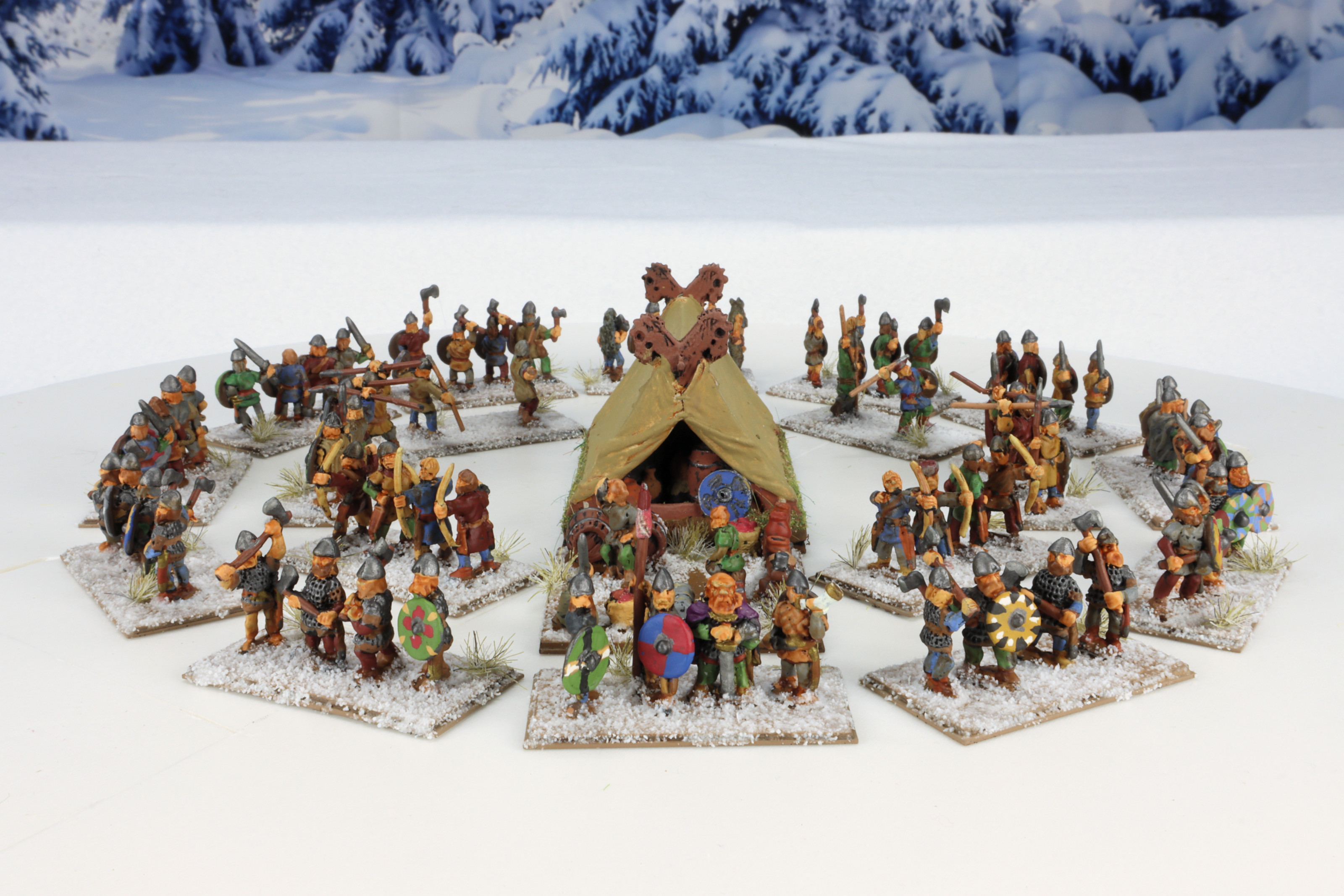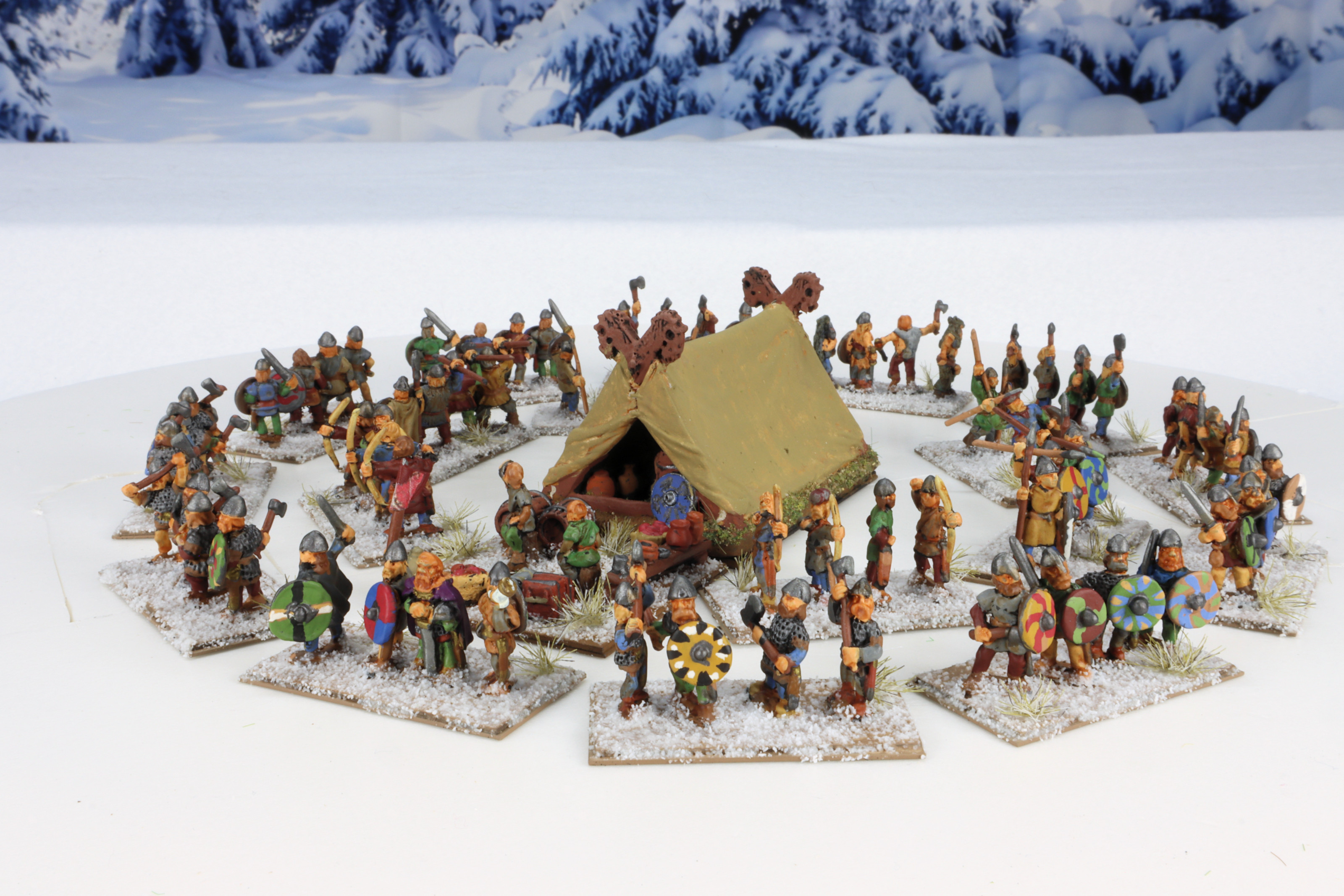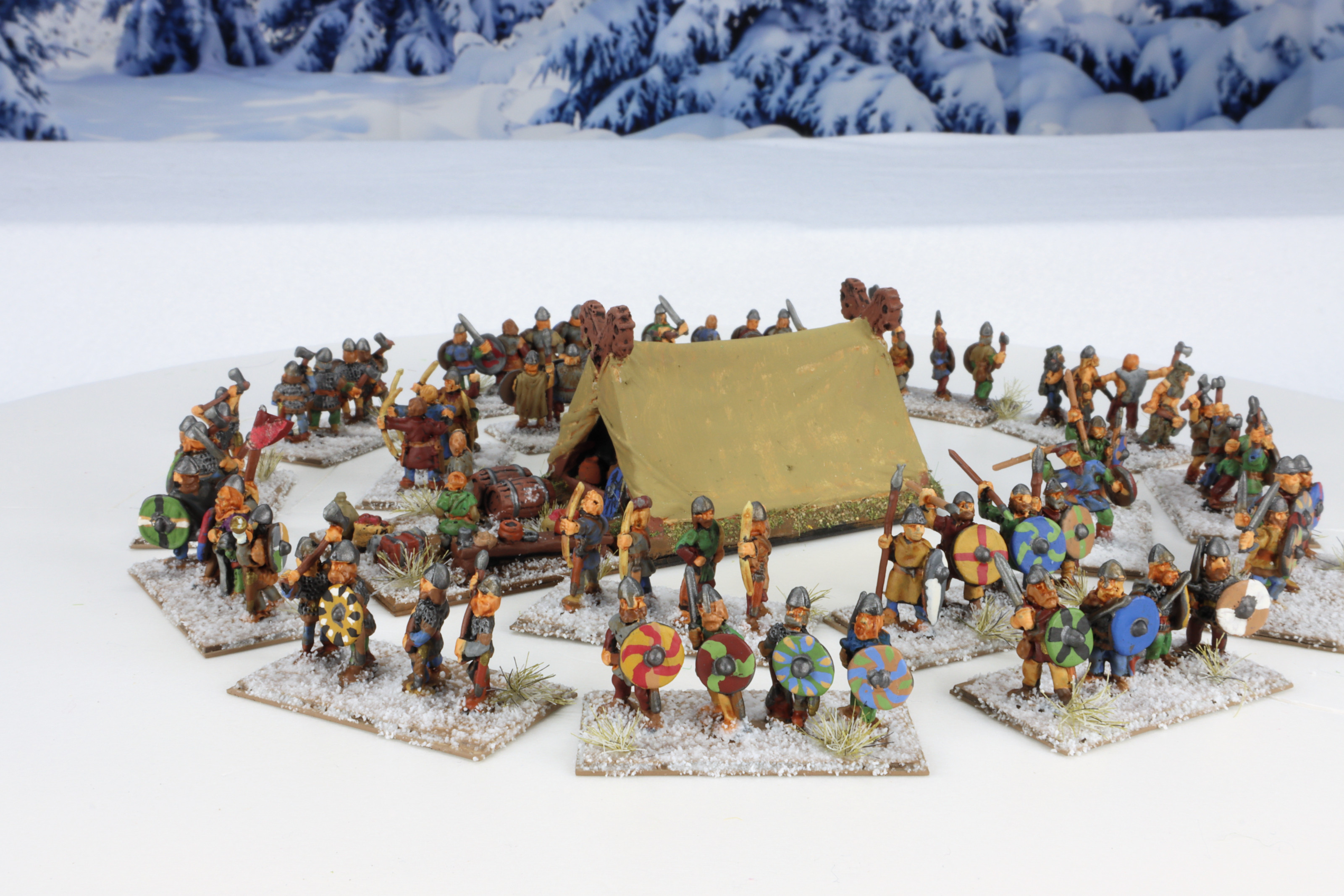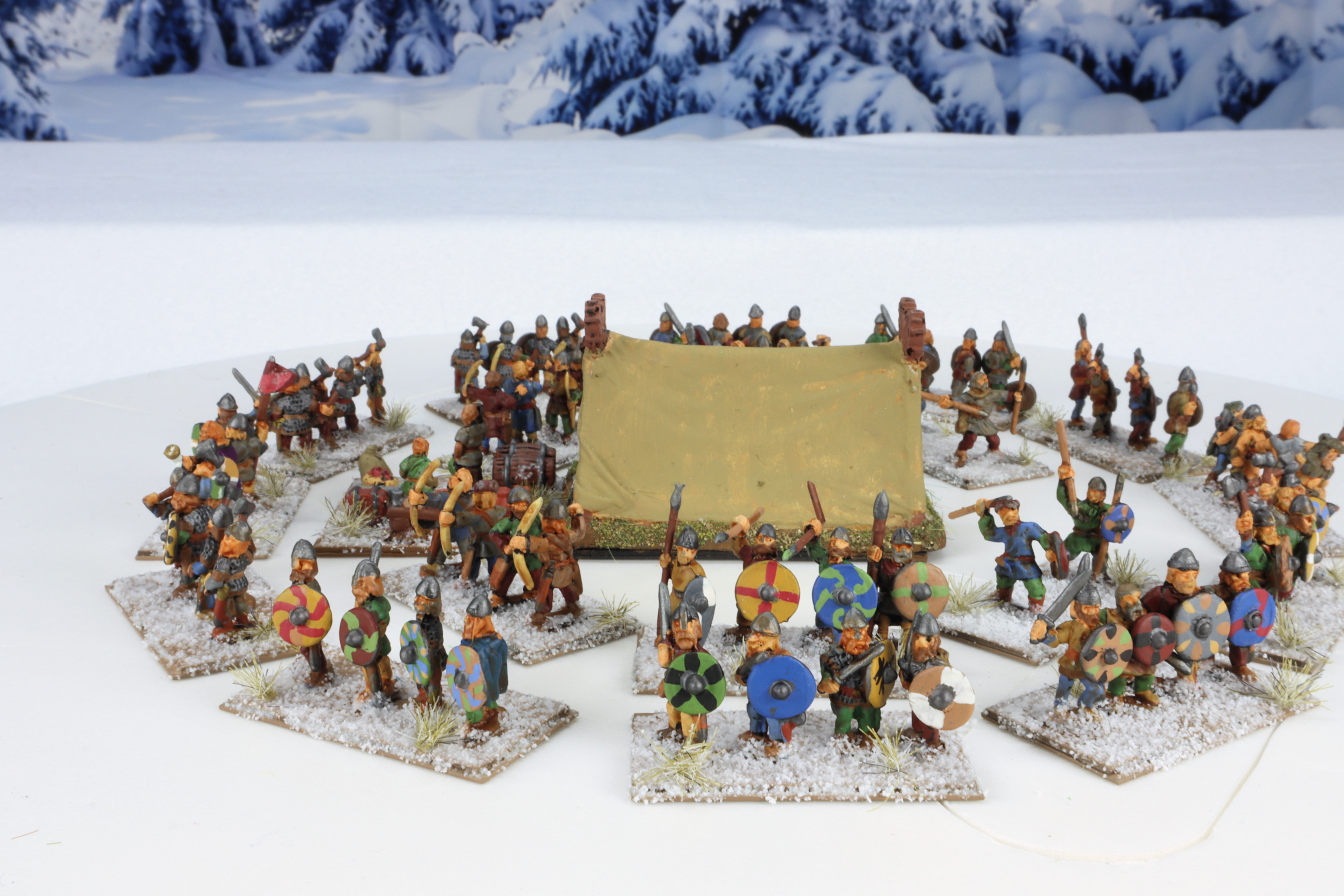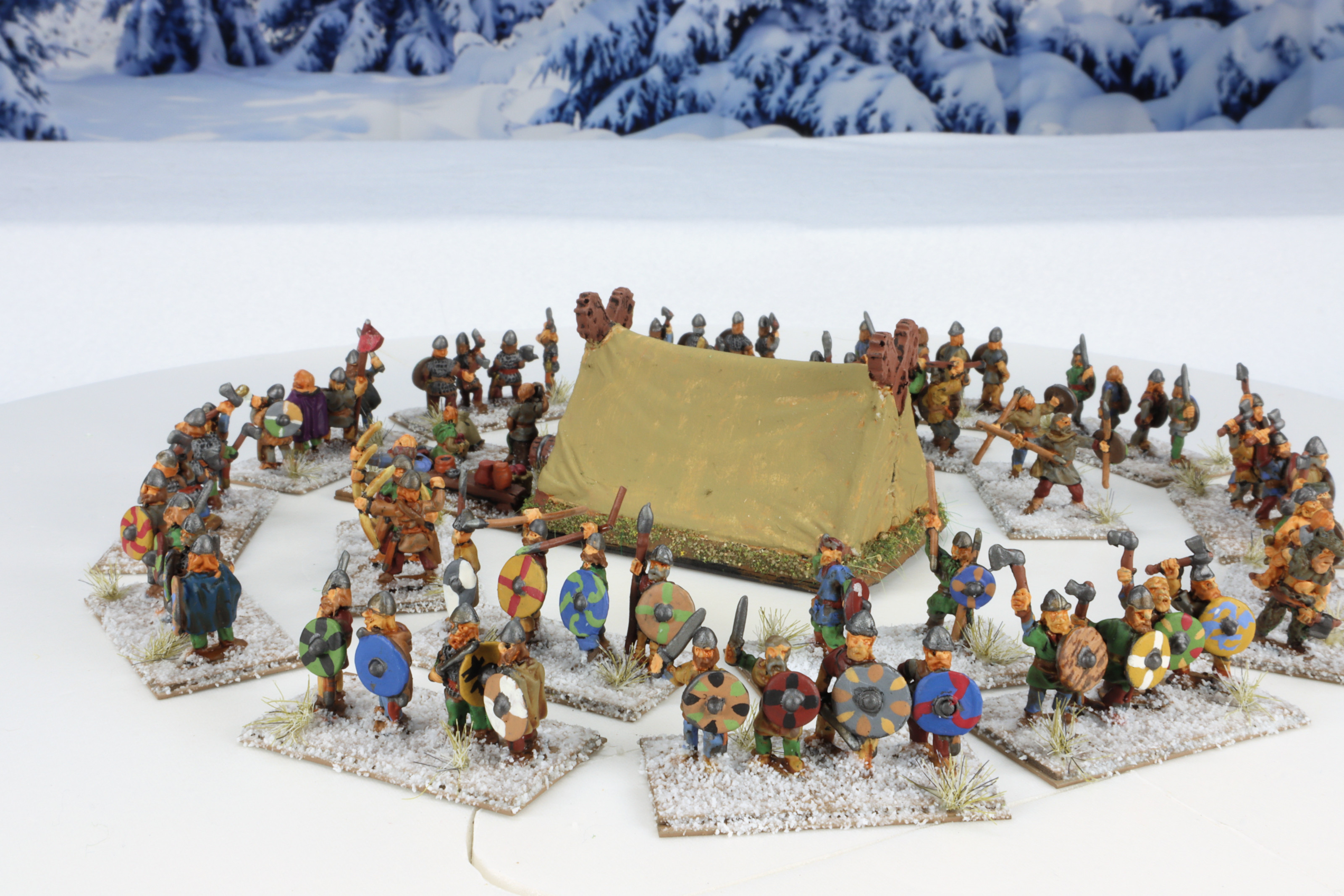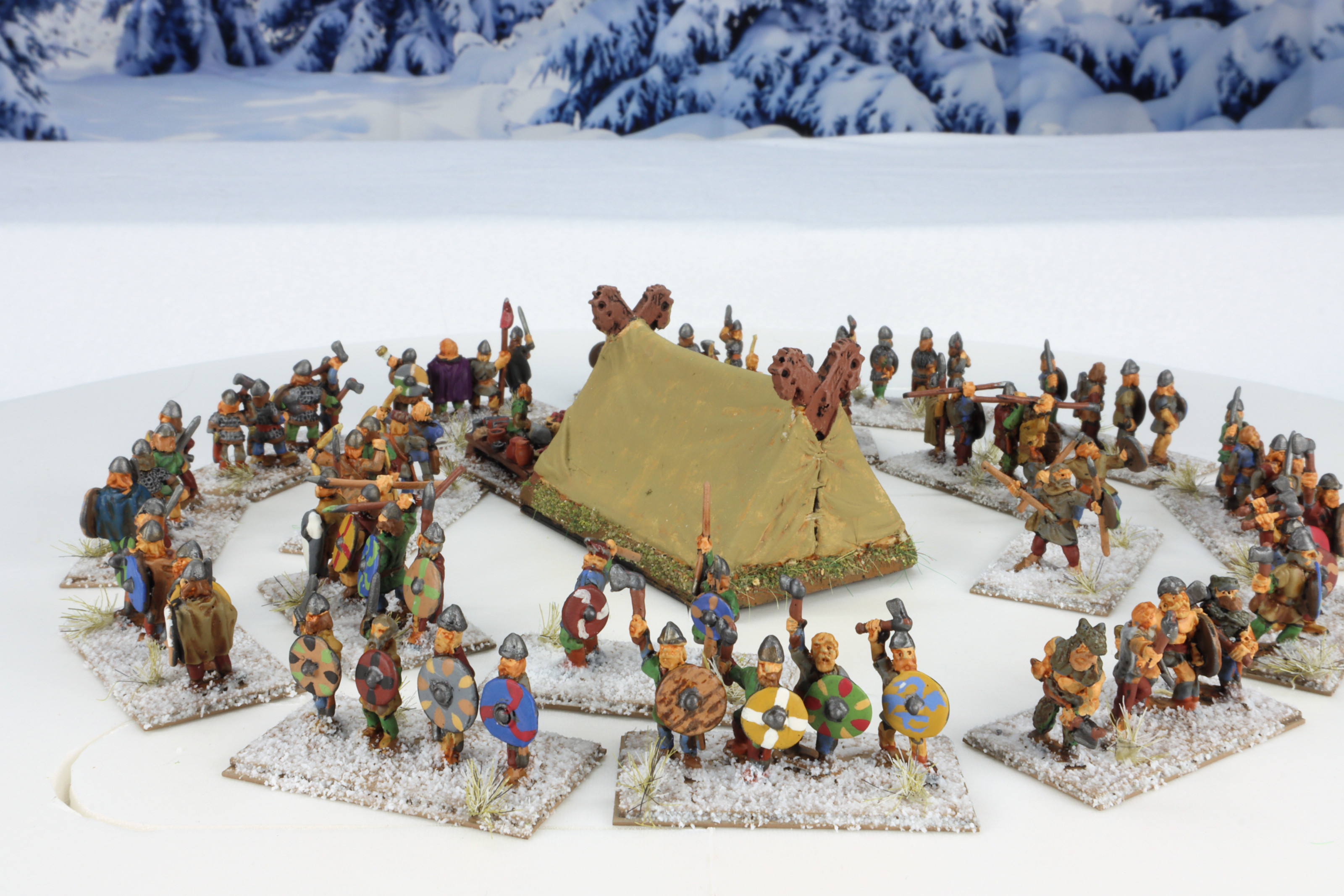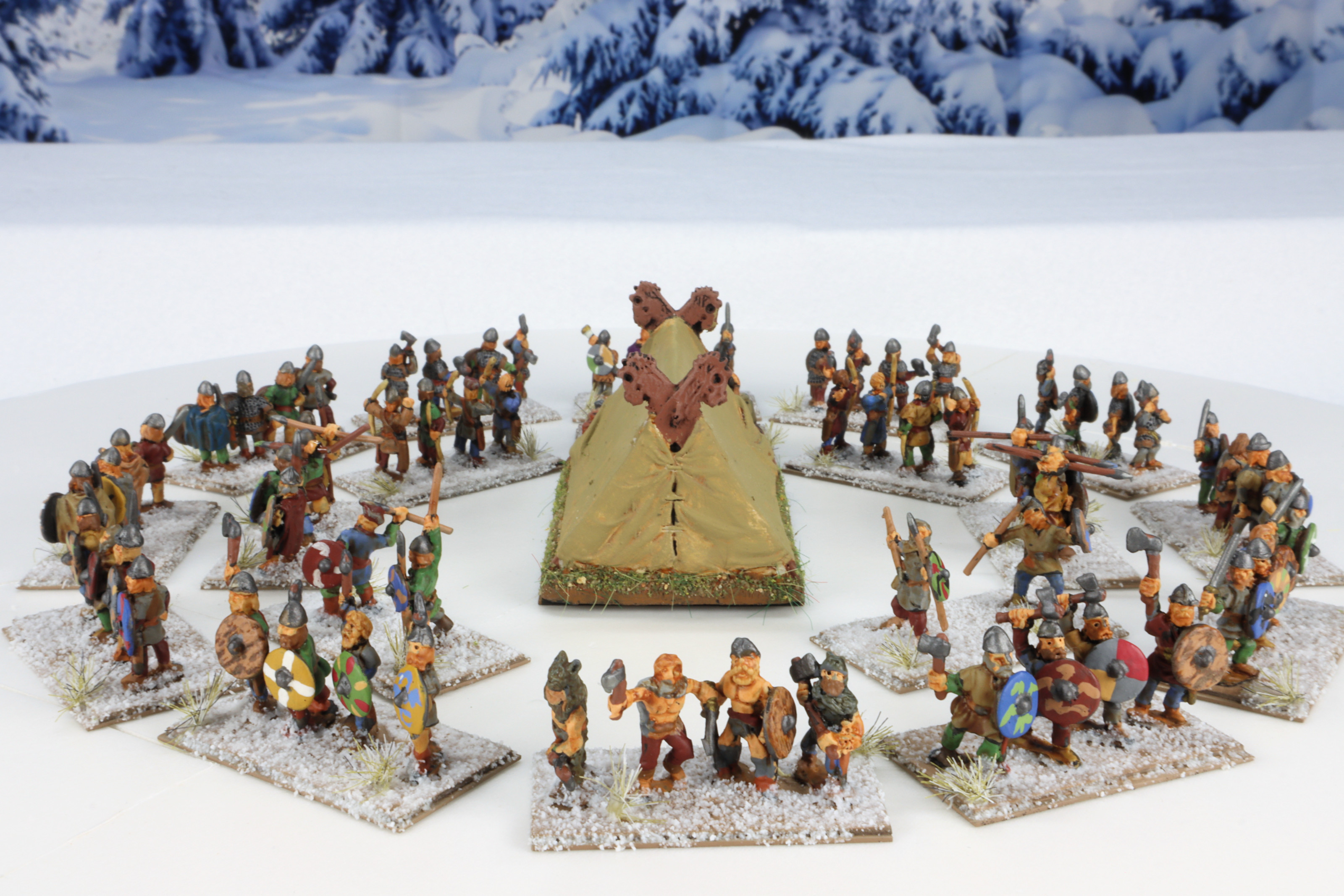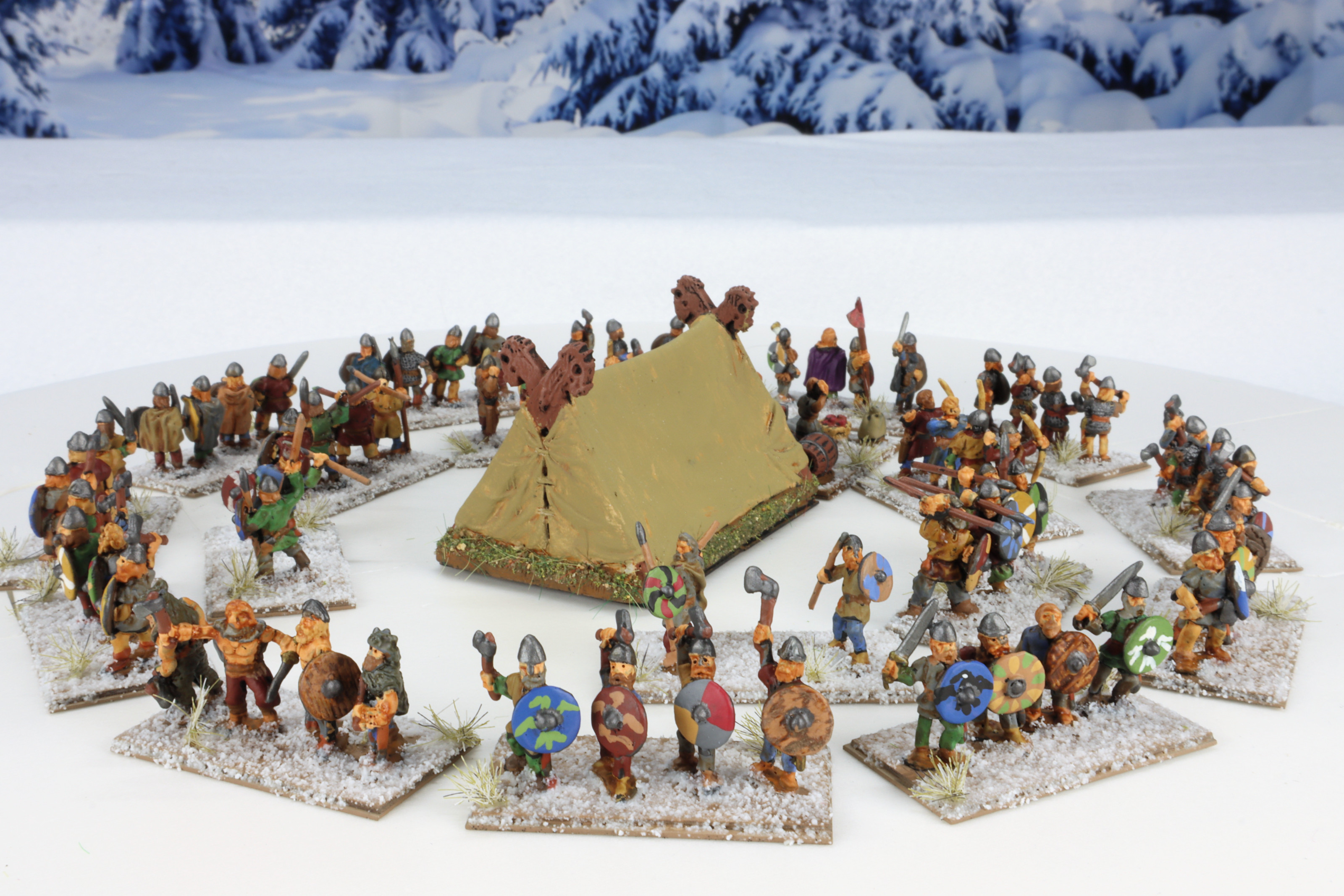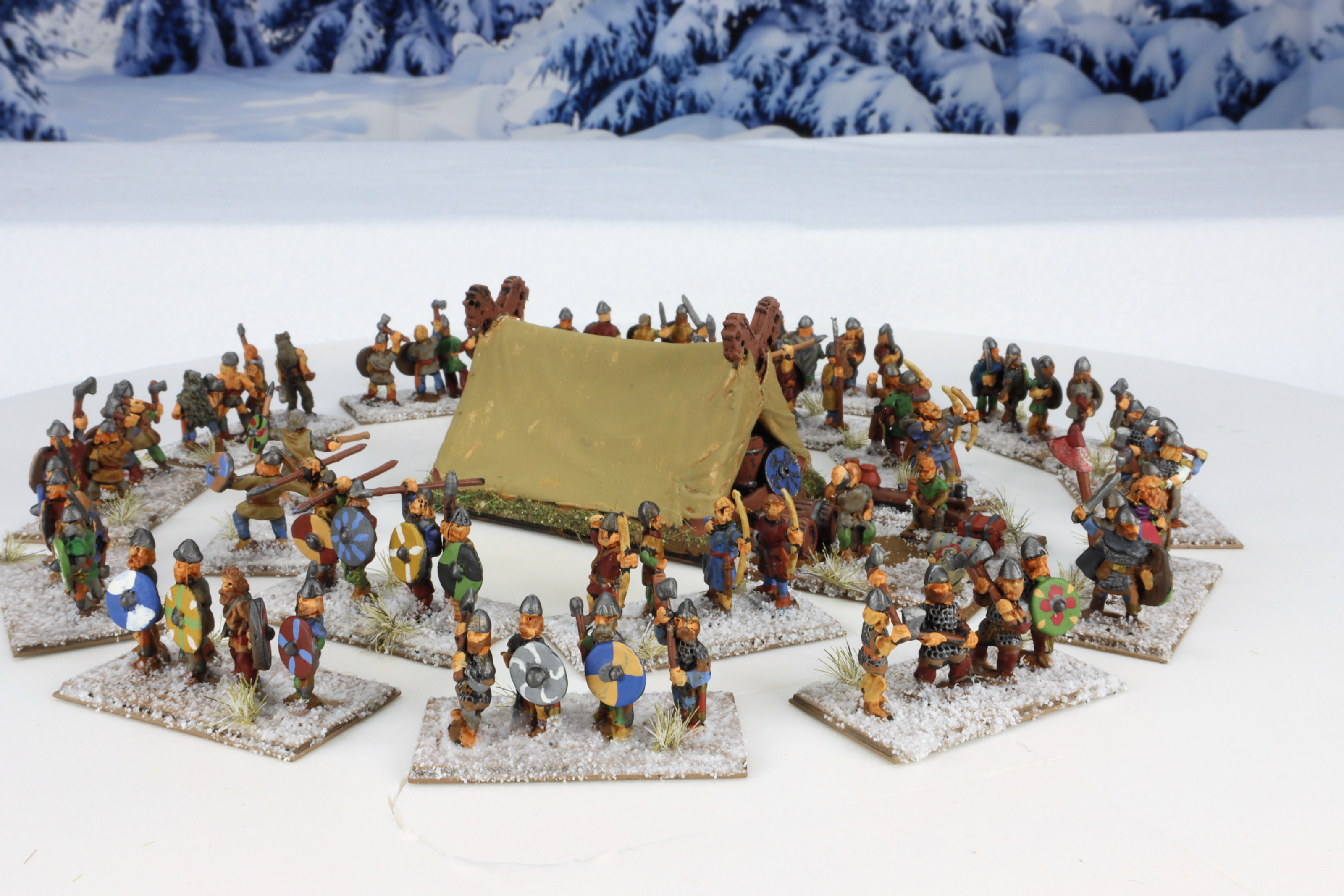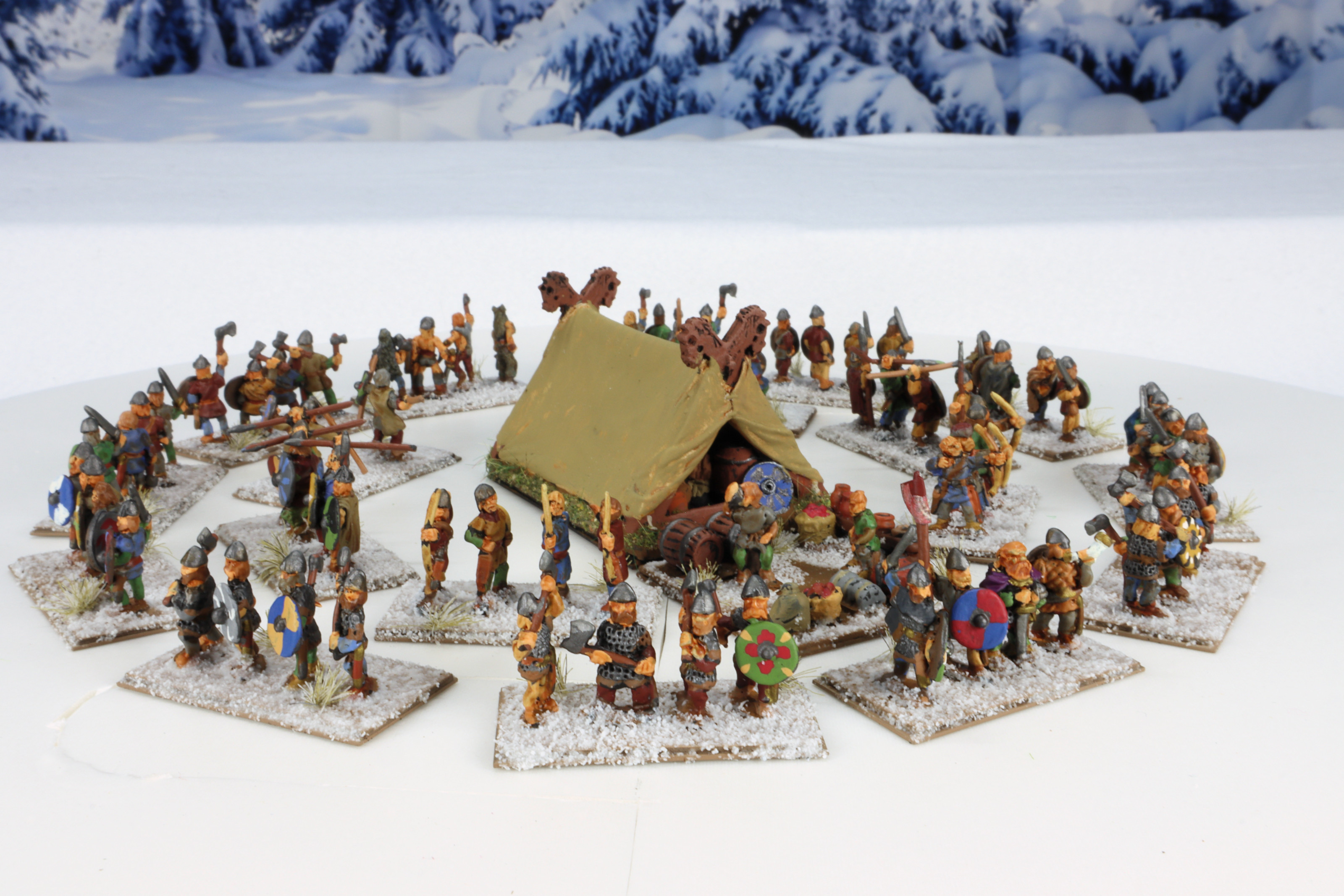
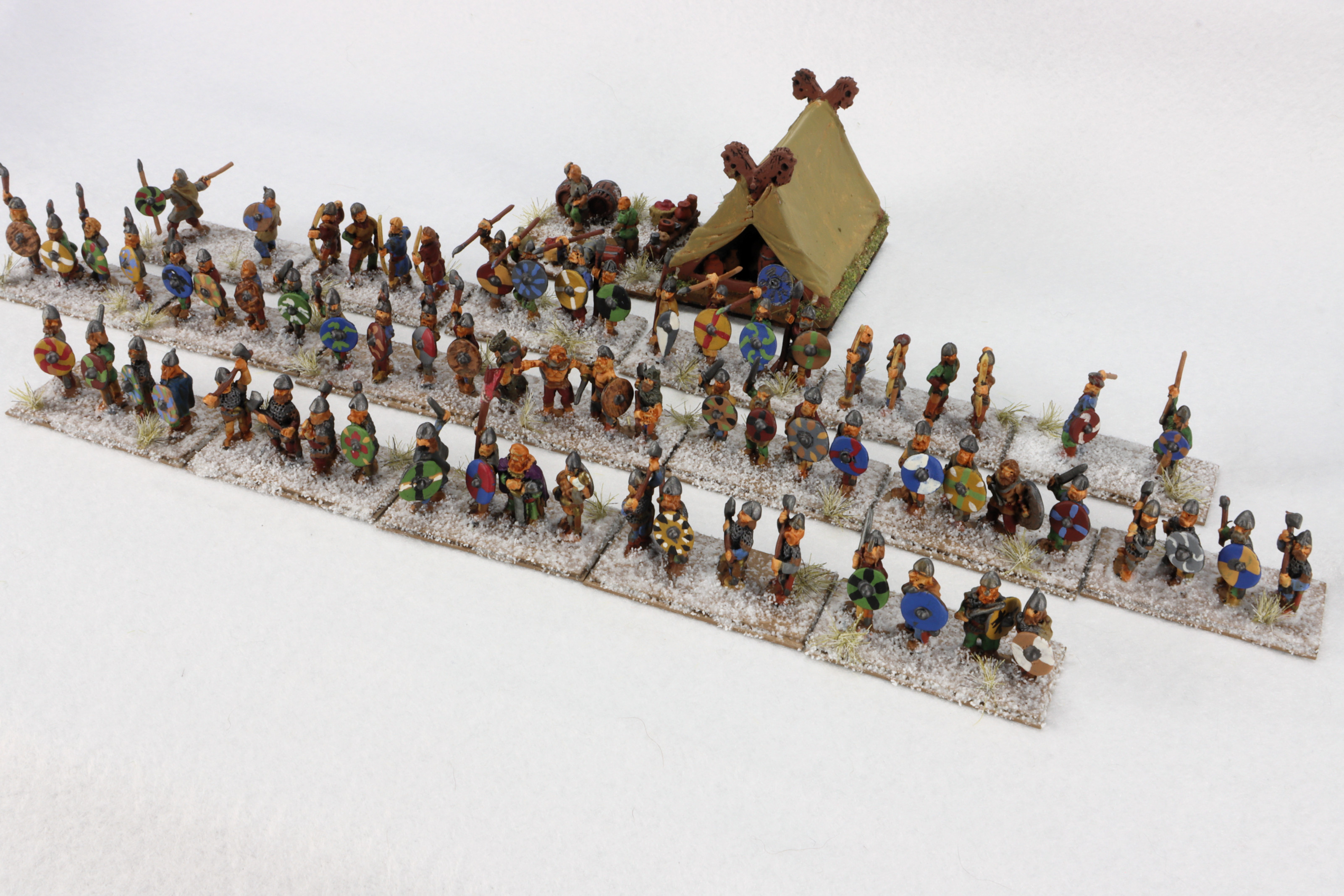
Baueda has been generous with the figure count for the army. First of all, you get an army general with three retainers. Then you get about twenty huscarl figuress in chain mail armor with blades (swords and axes). You get four berserkers and about twenty hird in tunics with blades. There are about twelve auxilia and psiloi with spears and javelins. There are eight bow and two camp thralls. Finally there is a resin camp tent and a few camp items.
So in all you get about 70 figures, enough for the eighteen warrior stands and two camp stands shown here.
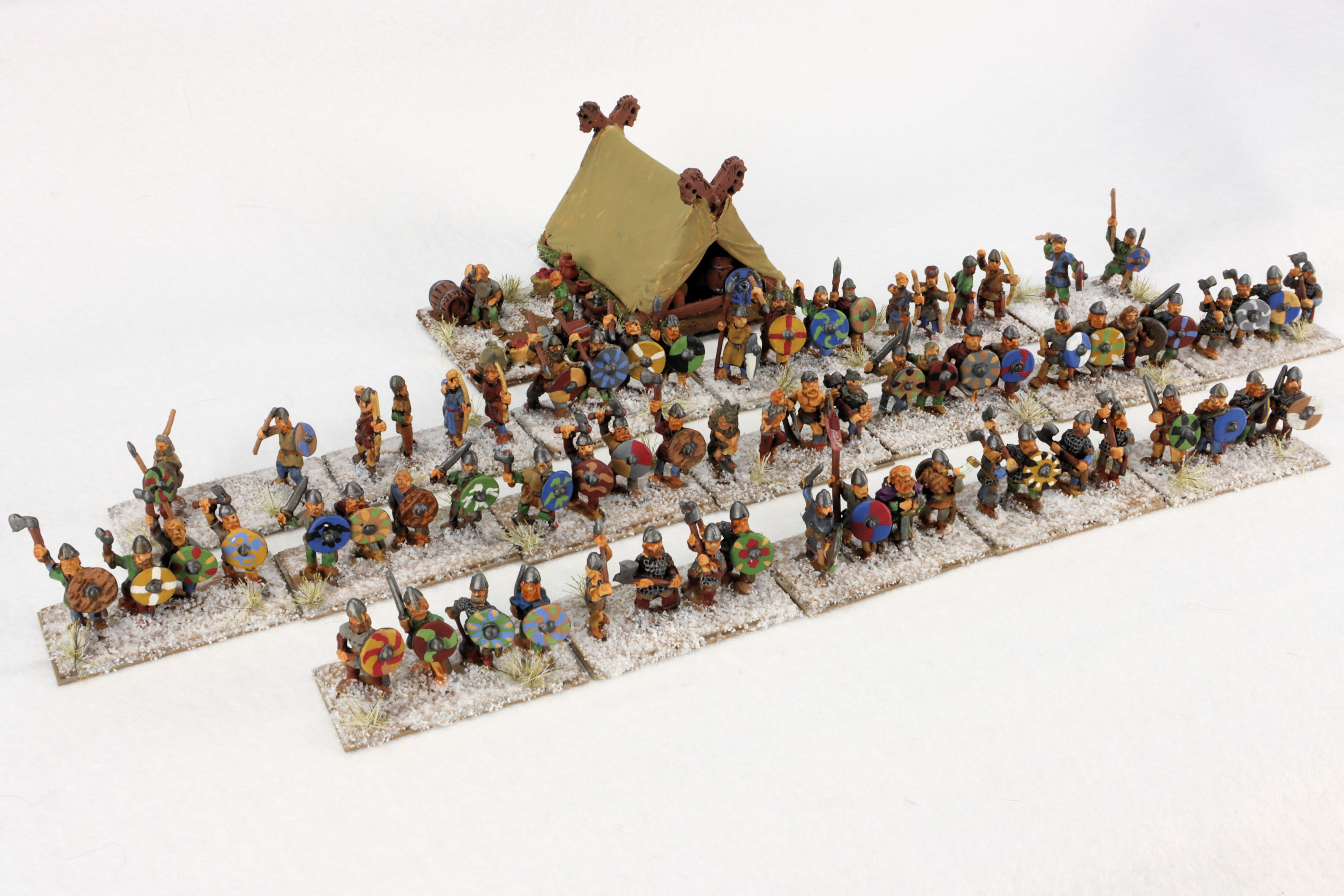
These figures are based about four warriors per stand for use with the De Bellis Antiquitatus miniature game, also known as DBA. DBA is popular because there are hundreds of armies in the rules lists, and each one has exactly 12 units. This Viking Raider army is from DBA version 3.0 (released 2014), the third book of armies (spanning the Dark Ages to early Medieval period), and is the 28th army of the book. is also known as DBA3 III/40.
The Viking DBA army III/40 has four variants a through d. Variants a and b are Viking raiders shown here. Variants c and d are the the Viking Leidang shown in my earlier article.
In DBA game terms, the units available to the Viking Leidang DBA3 III/40 a and b and armies are blades (Bd), auxillia (Ax), warband (Wb), archers (Bw), psiloi (Ps) or loose formation harassing troops. This table shows the options. For DBA the total number of units should be 12 units.
| Option | Amount | Description | Type |
|---|---|---|---|
| 1 | General | 4Bd | |
| 10 | huscarls or hird | 4Bd | |
| 1 | Berserks | 4Bd or 3Wb | |
| 2 | Archers | 4Bw or Ps | |
| 1 | Raiders or Irish | 3Ax |
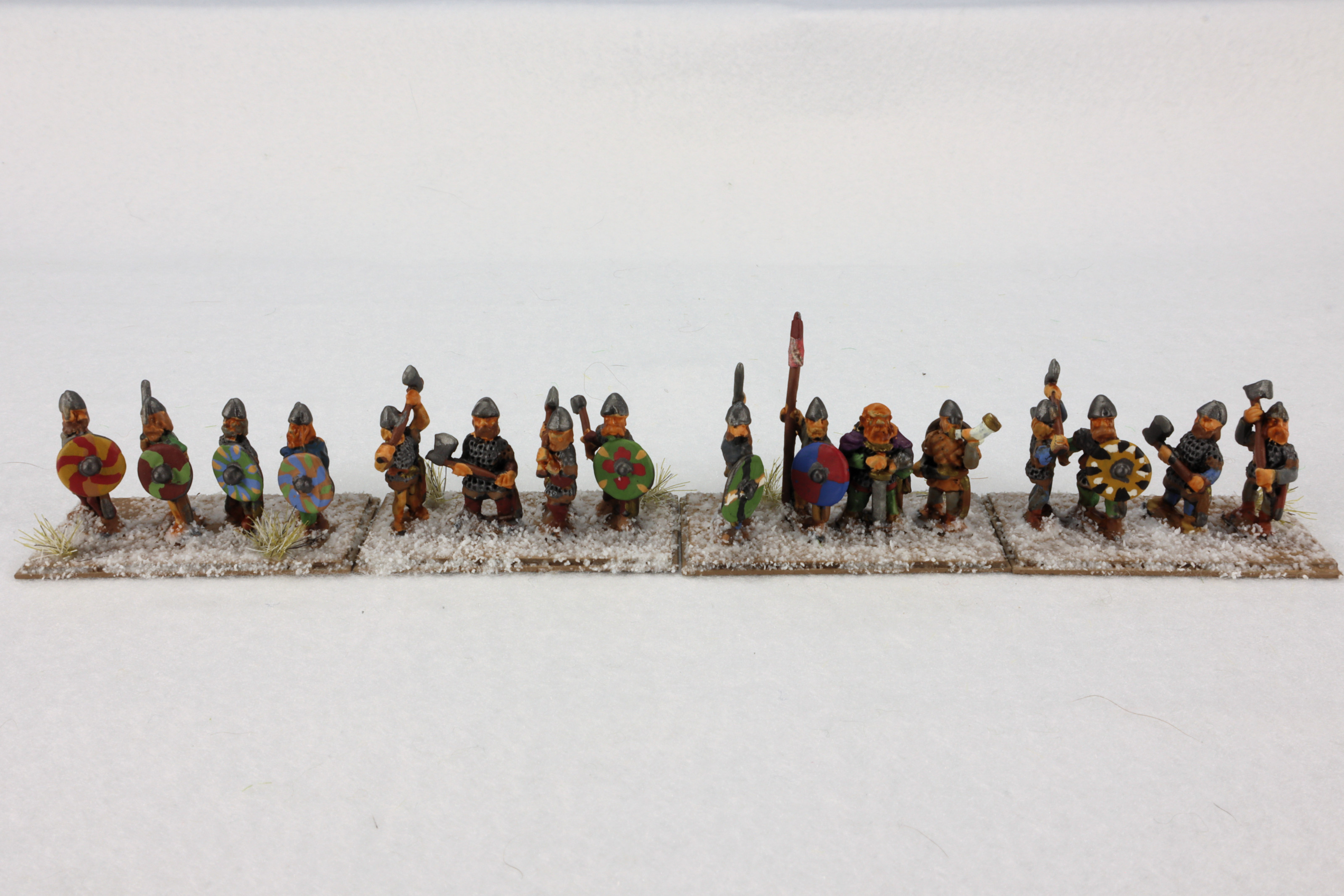
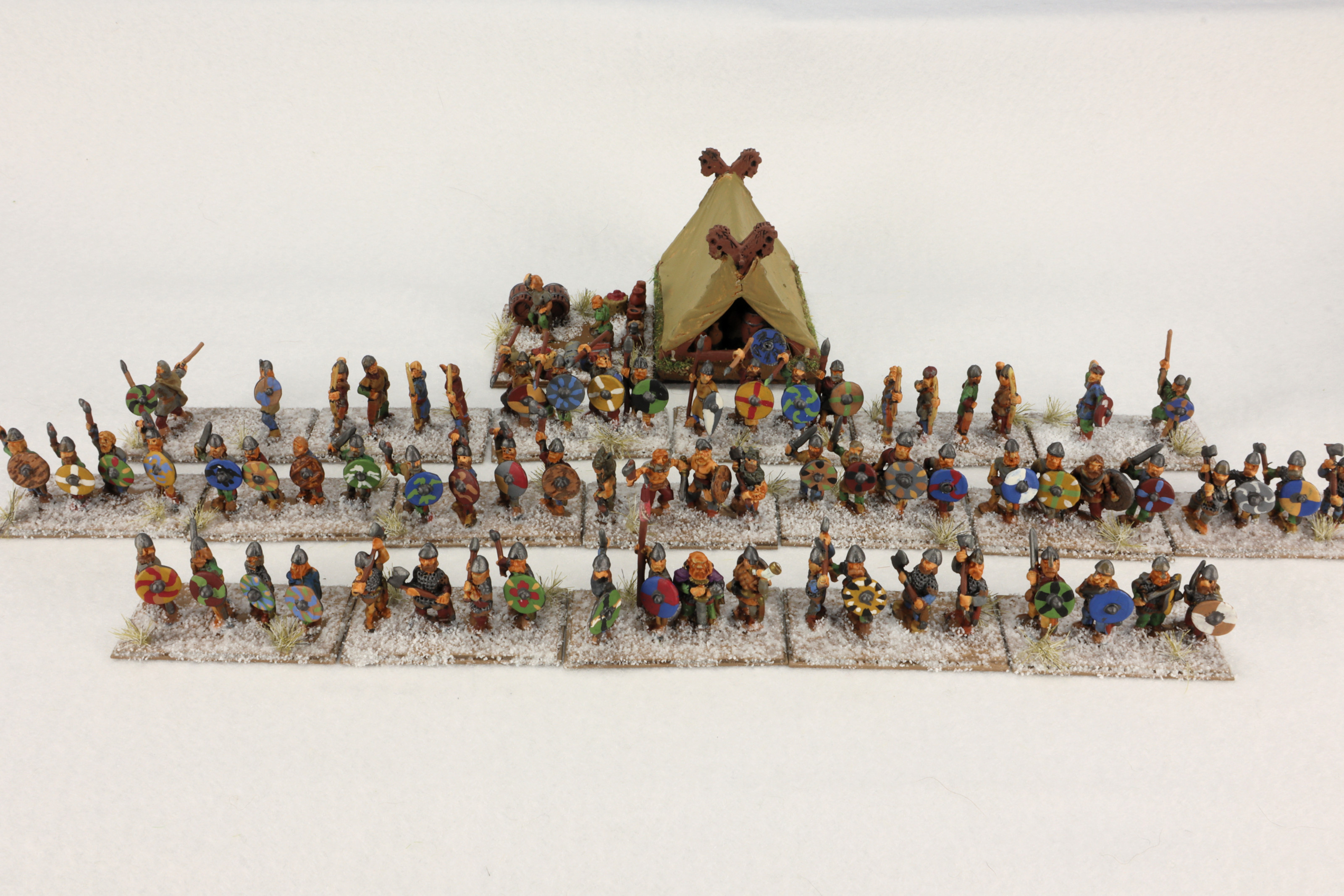
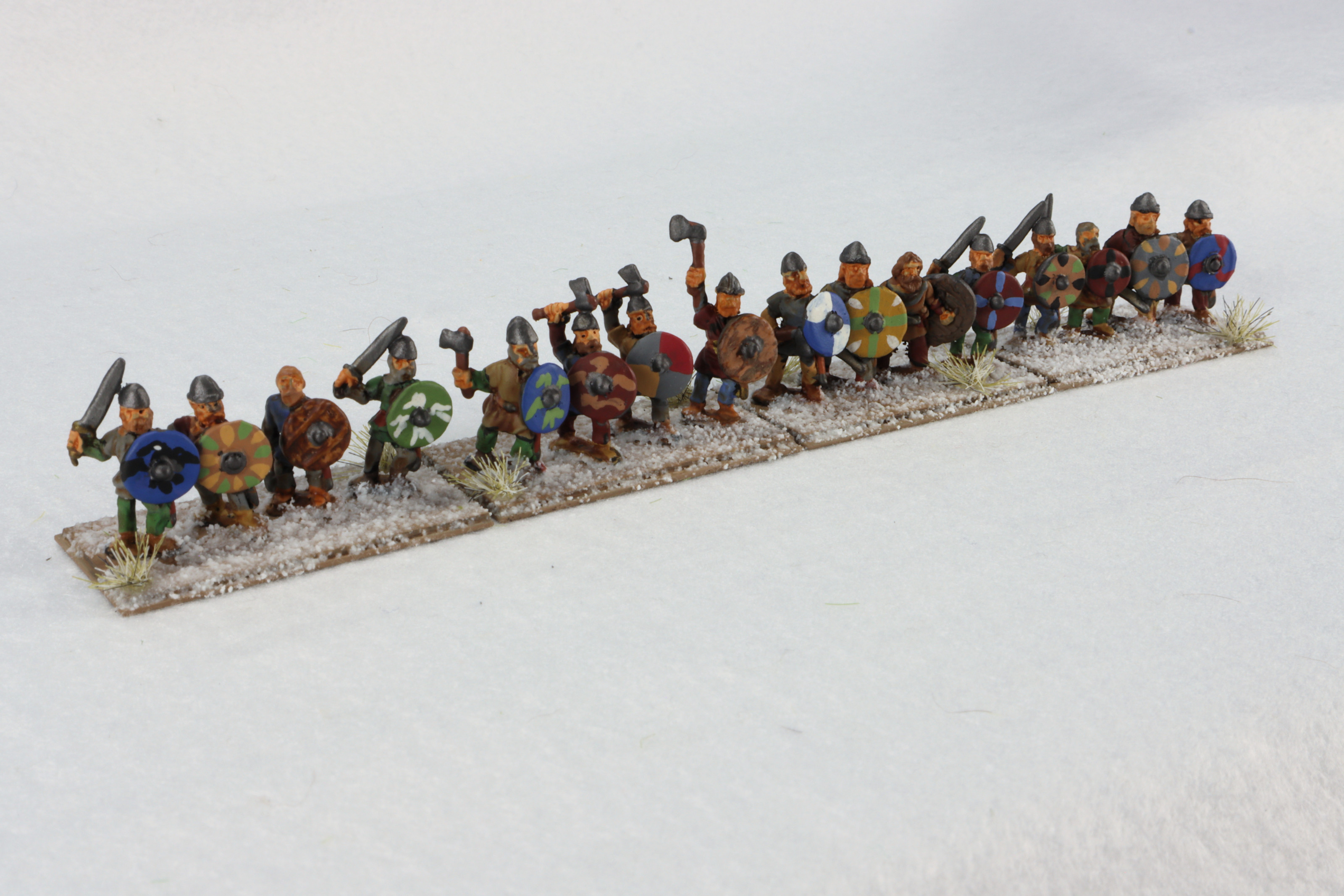
The General and his retinue are the third base from the left. The remaining bases are huscarls with chain mail armor, swords, and axes.
Note that this Viking Raider army has no mounted units. The army is entirely foot soldiers with an abundance of swords and axes.
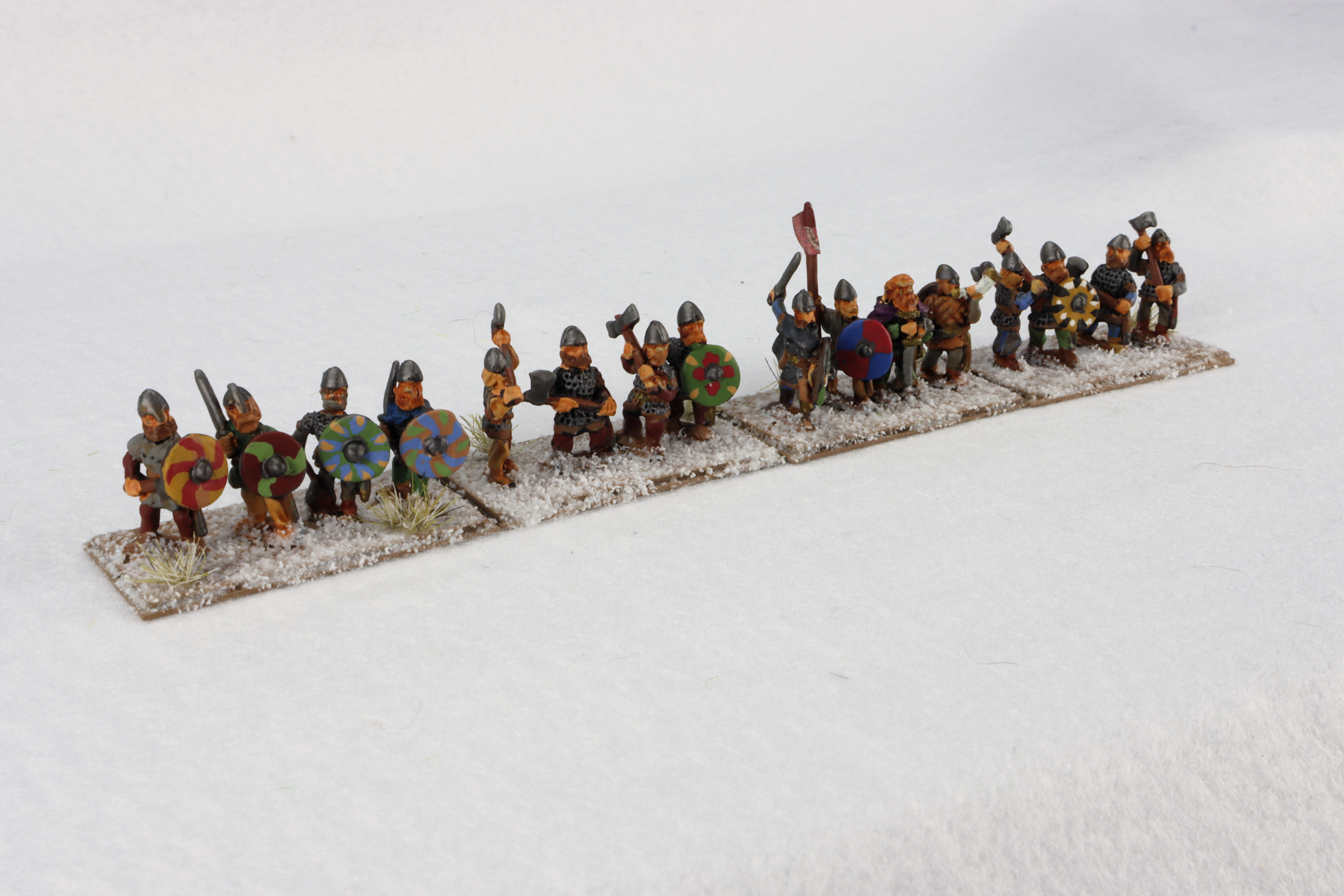
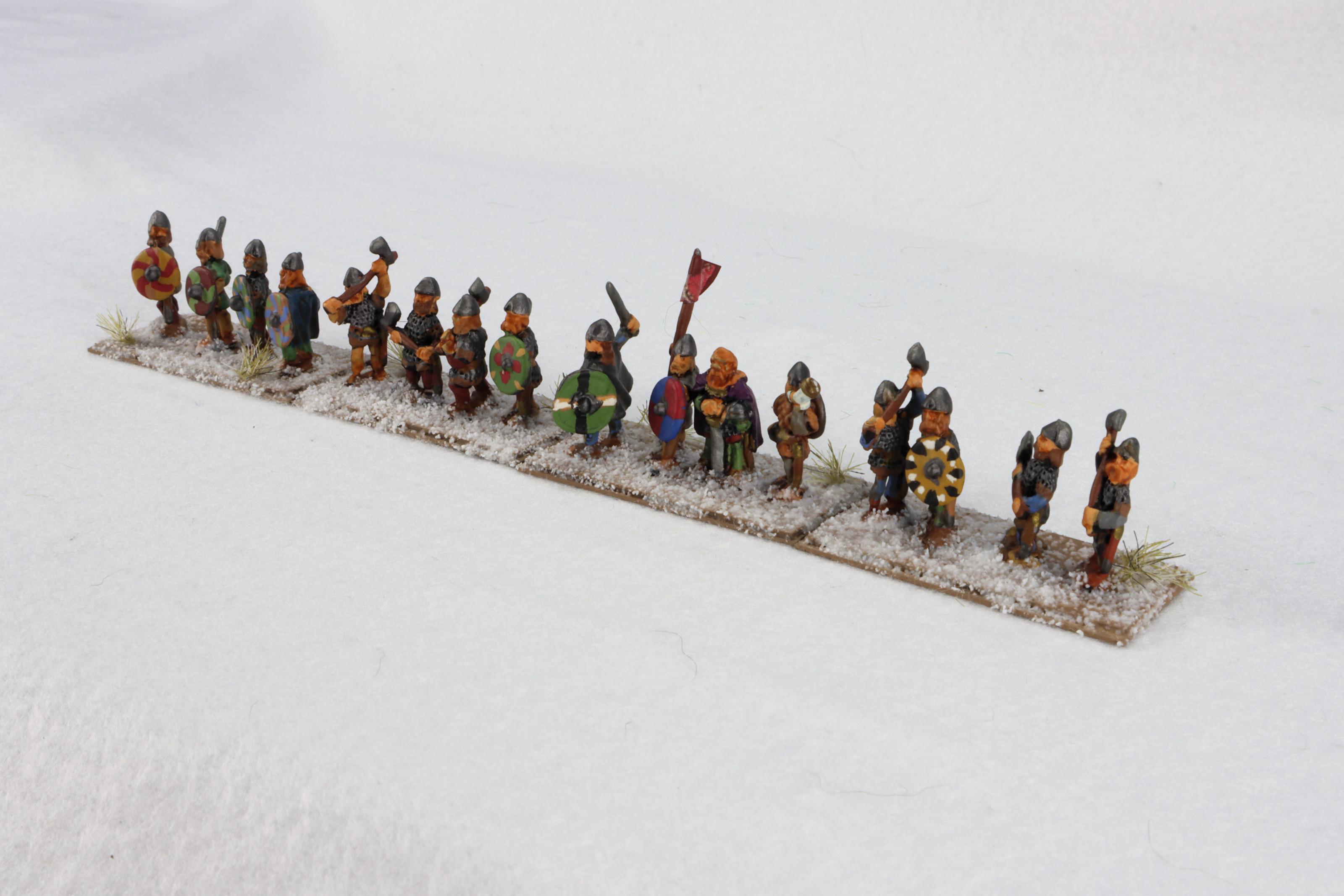
My painting recipe for these 15mm minis is to prime them with black paint. I then used Vallejo Model Color acrylics thinned down to block in the major colors. Details such as armor and weapons are painted in. The shields are hand painted with various Viking motifs. I opted not to use any wash or shade for the final step. They might look a little cartoony with these close up photos, but the colors of these tiny miniatures do look a bit brighter from an arm's length away.
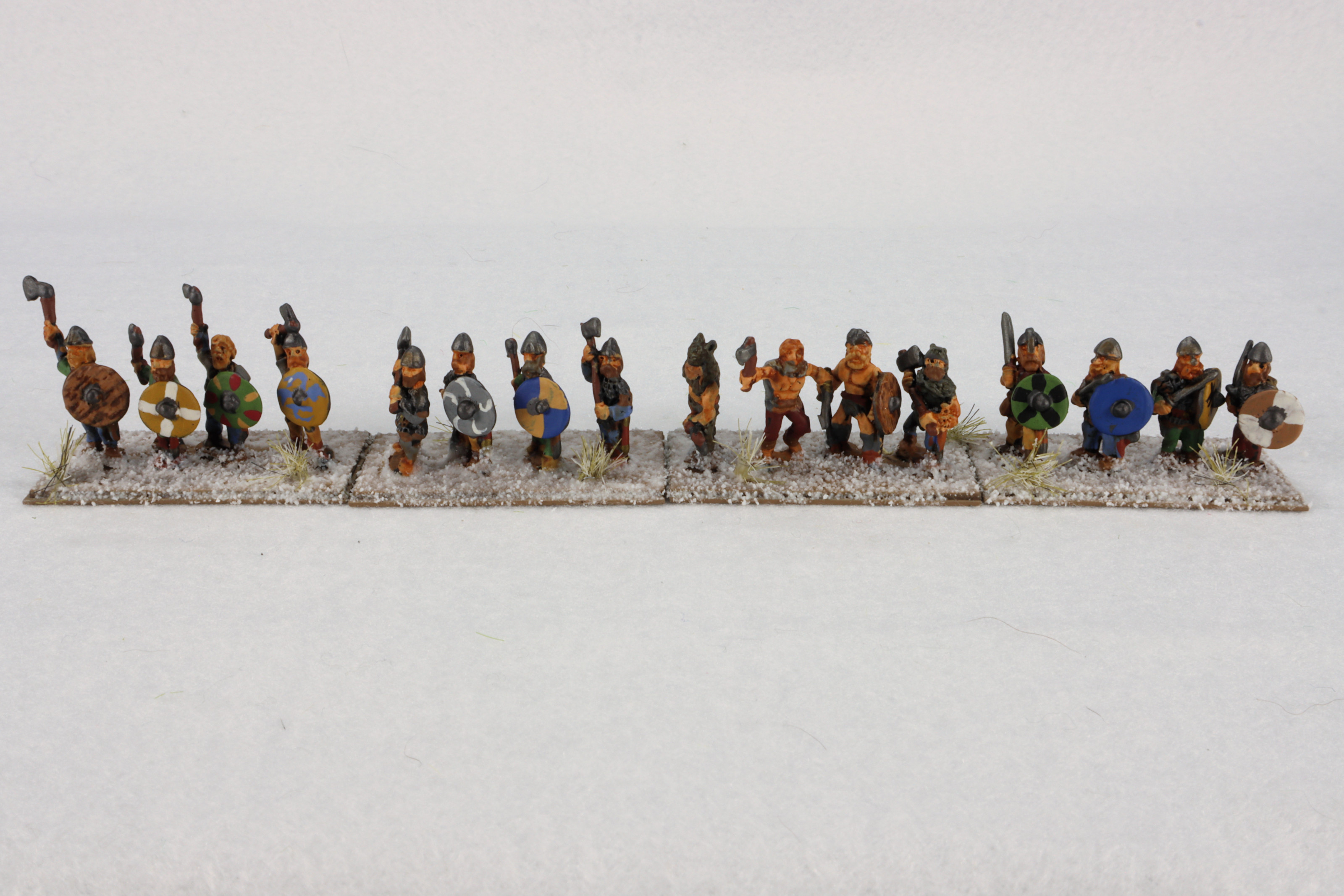
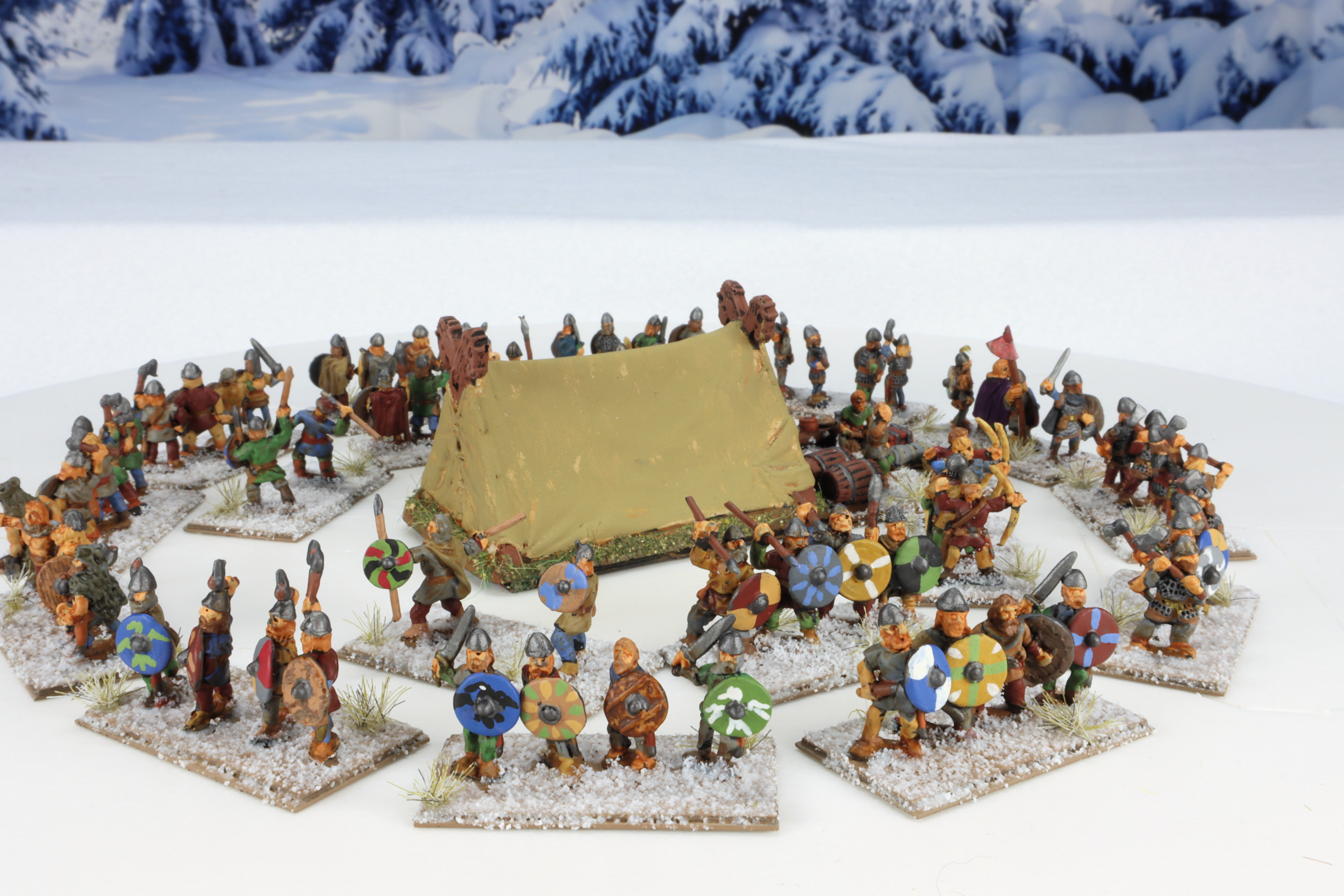
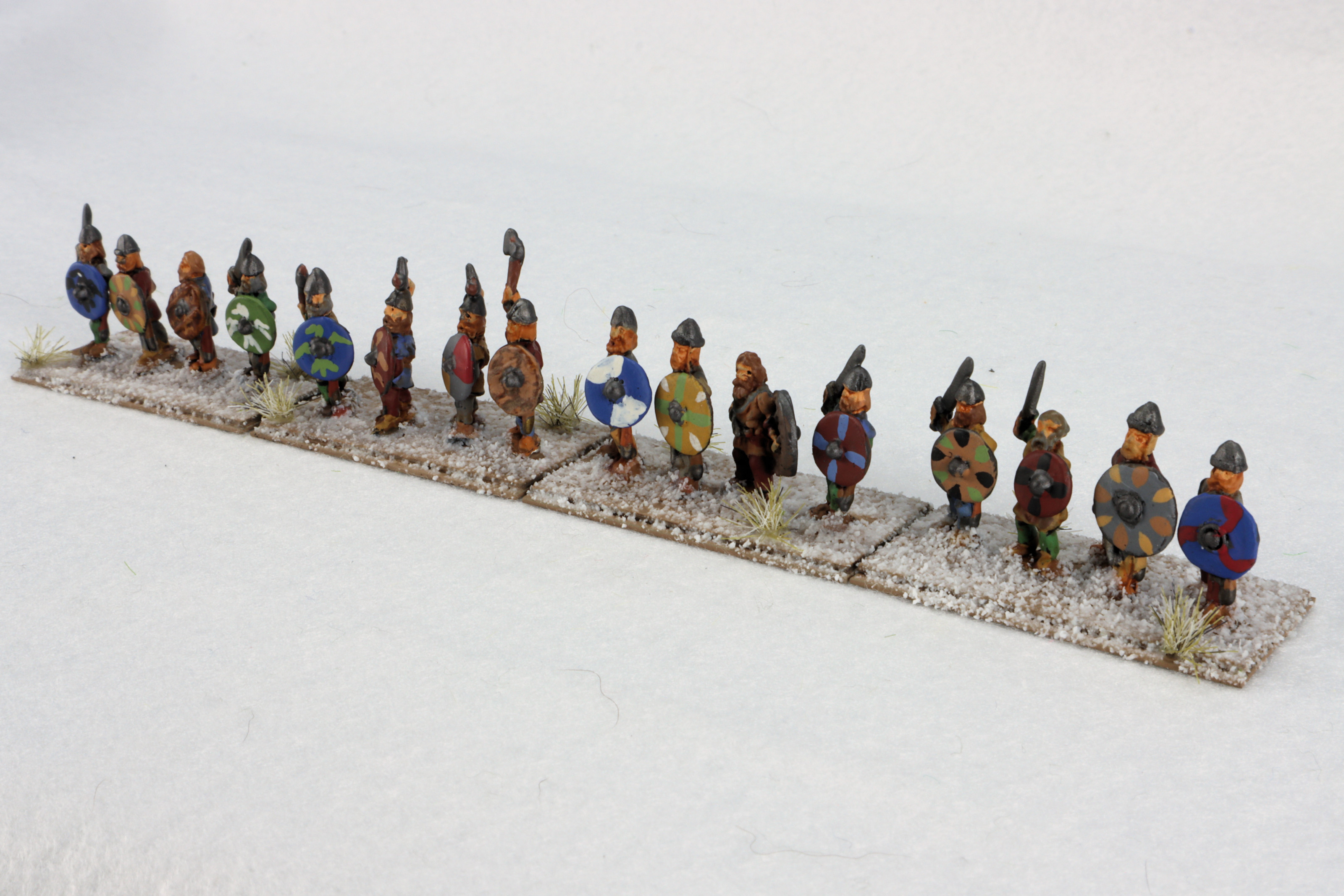
The beserks are the third unit from the left with the bear and wolf skins. The remainder are huscarls or hird with tunics blades and shields.
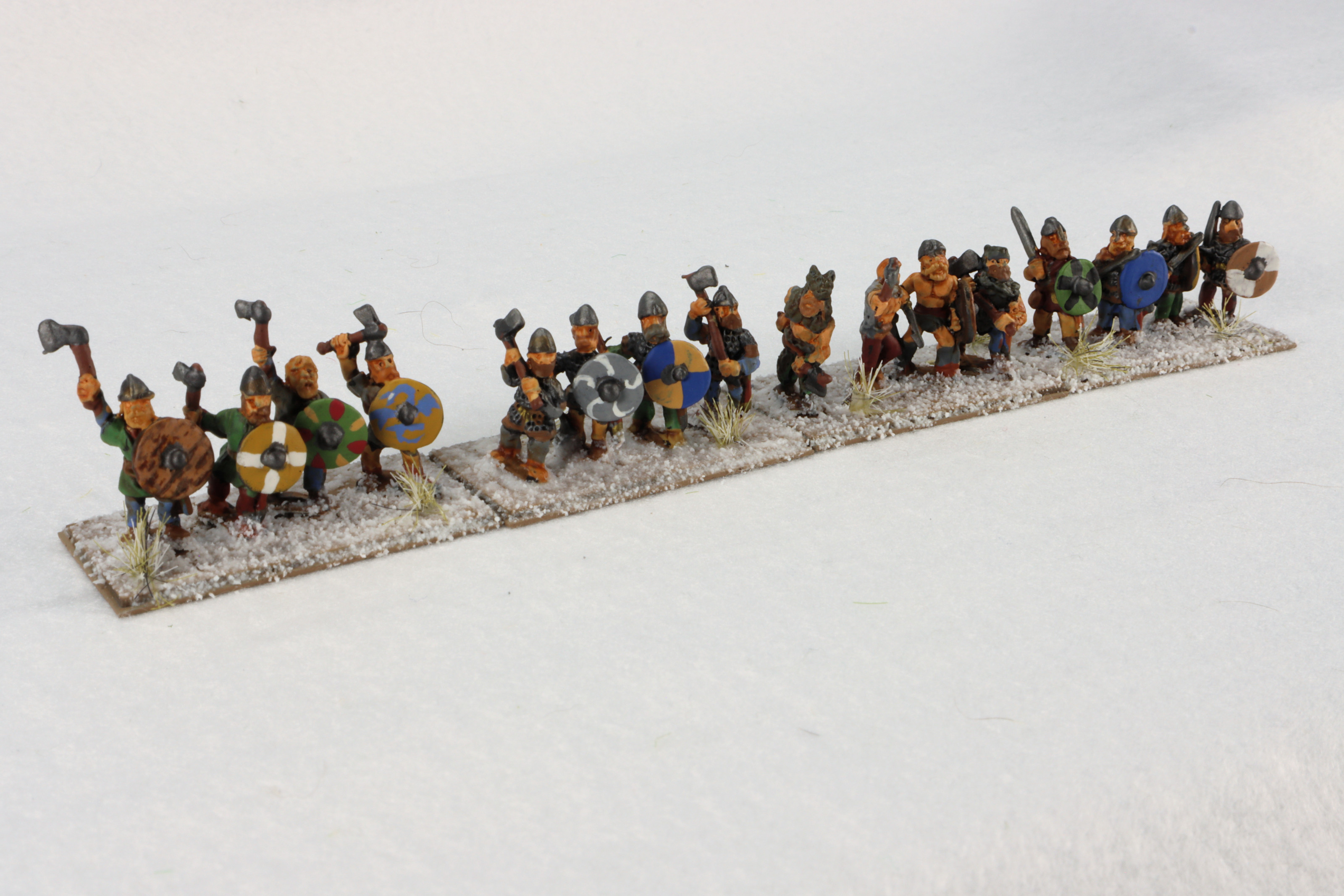
This angle is a good view for the hand painted shields.
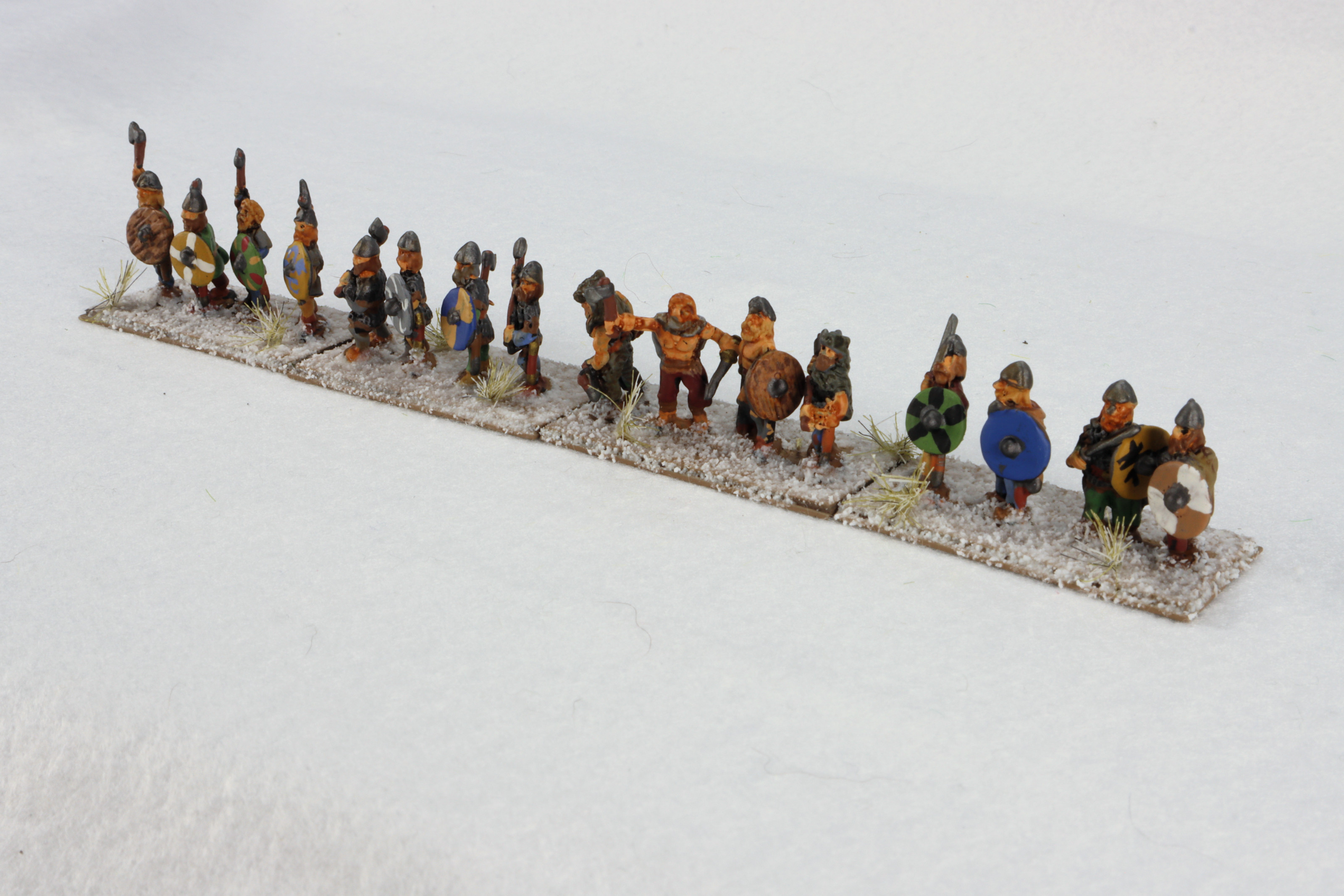
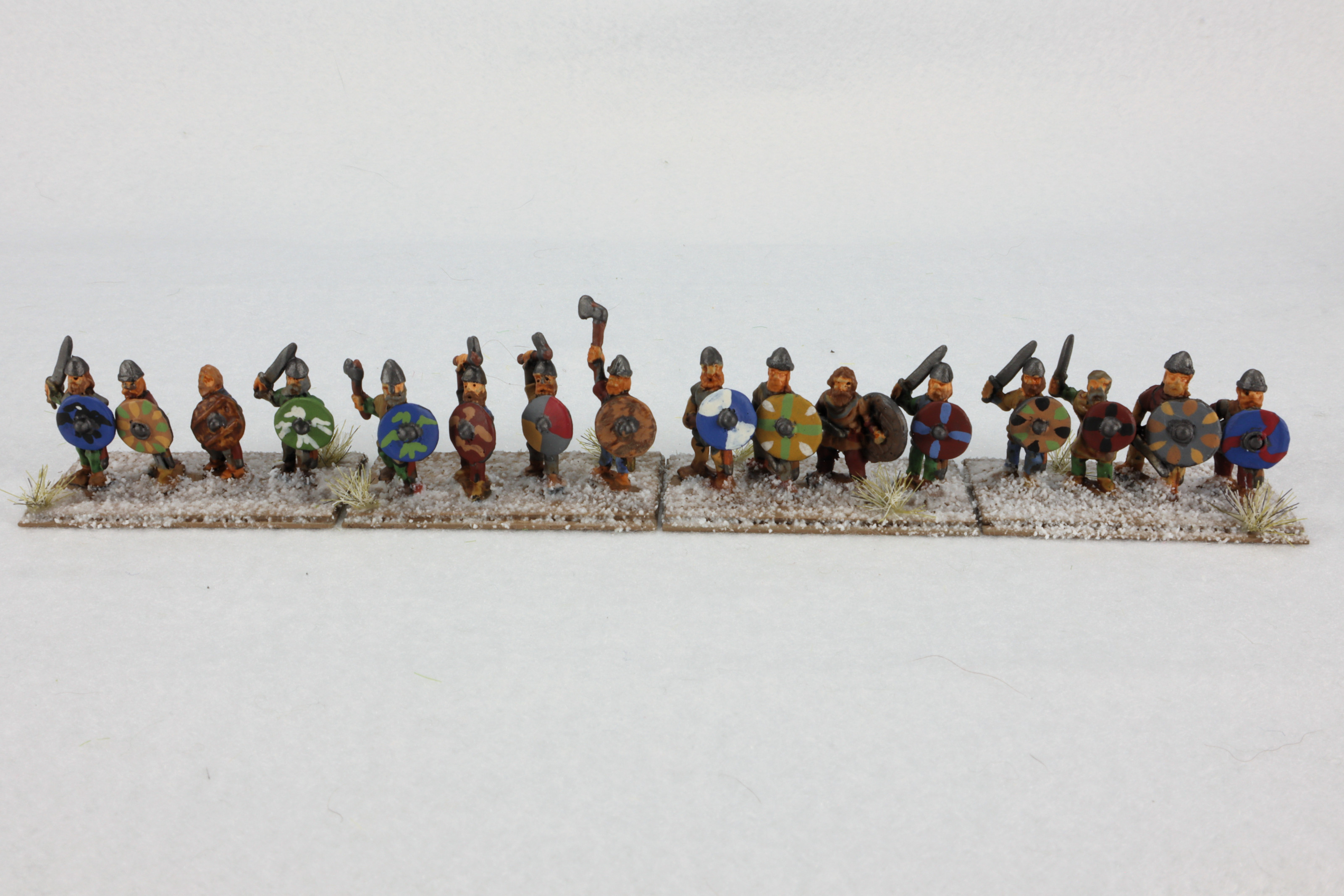
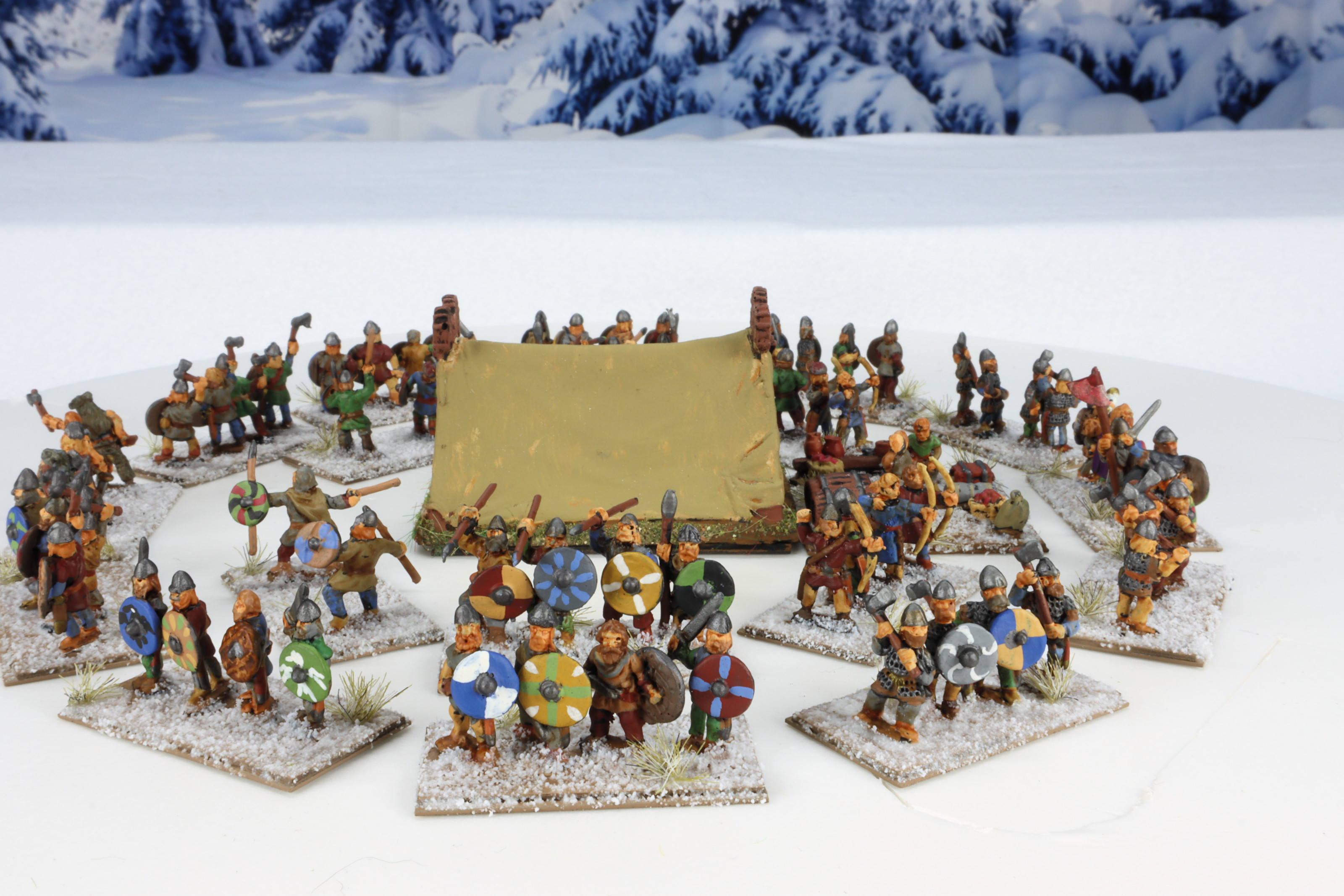
In DBA rules, you typically would put 3 models on a 30 by 40 mm base for a "fast" blade unit. You put 4 models for a "solid" blade unit. Fast units more farther in one turn, but are more likely to recoil from battle results. Solid unit conversely don't move as far, but stand in battle.
I always tend to base with 4 figures as I like the mass army look. In a game, I would alert my opponent which units are which.
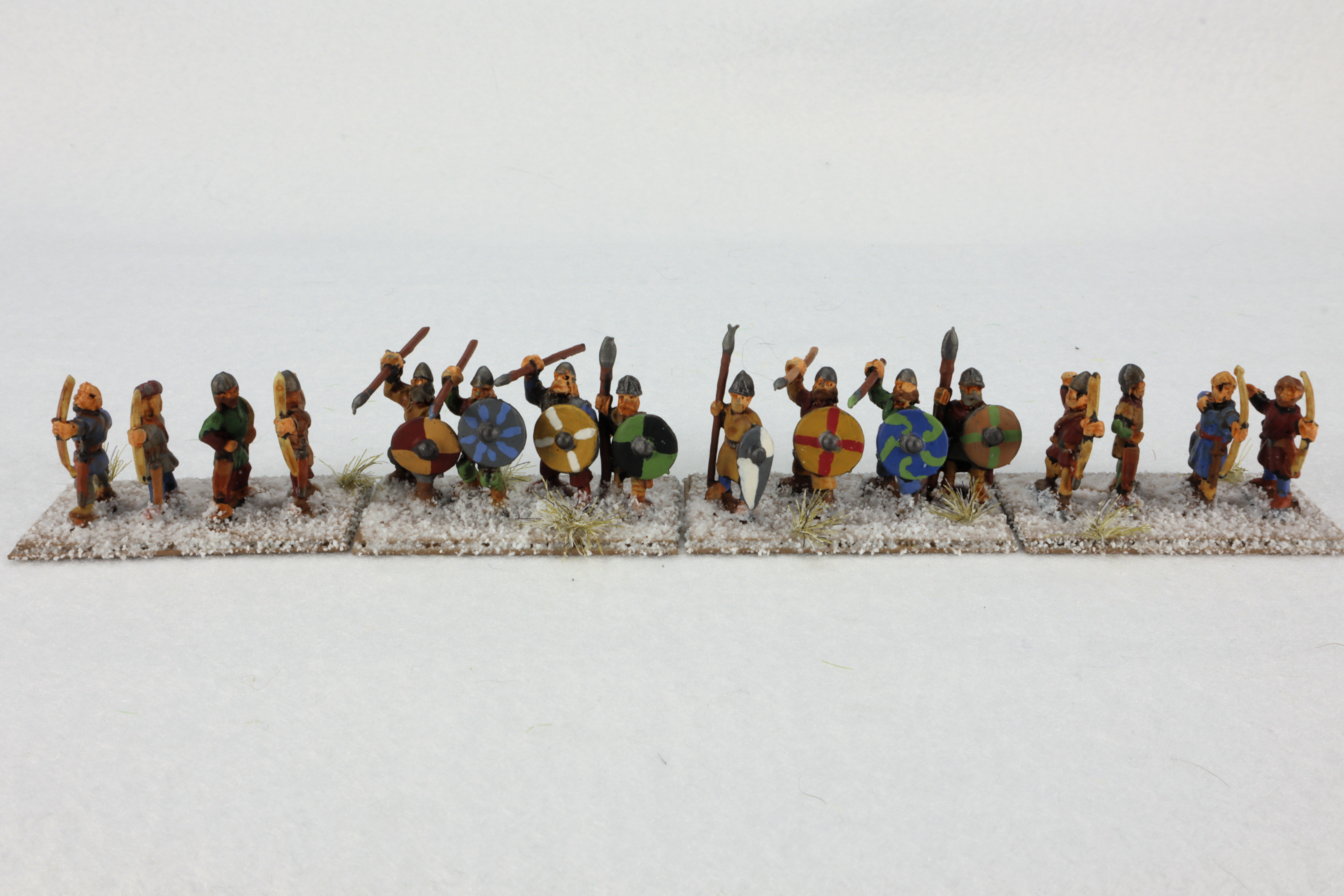
The two end units are archers. The two center uinits are auxilia which were typically lesser quality hired or allied units.
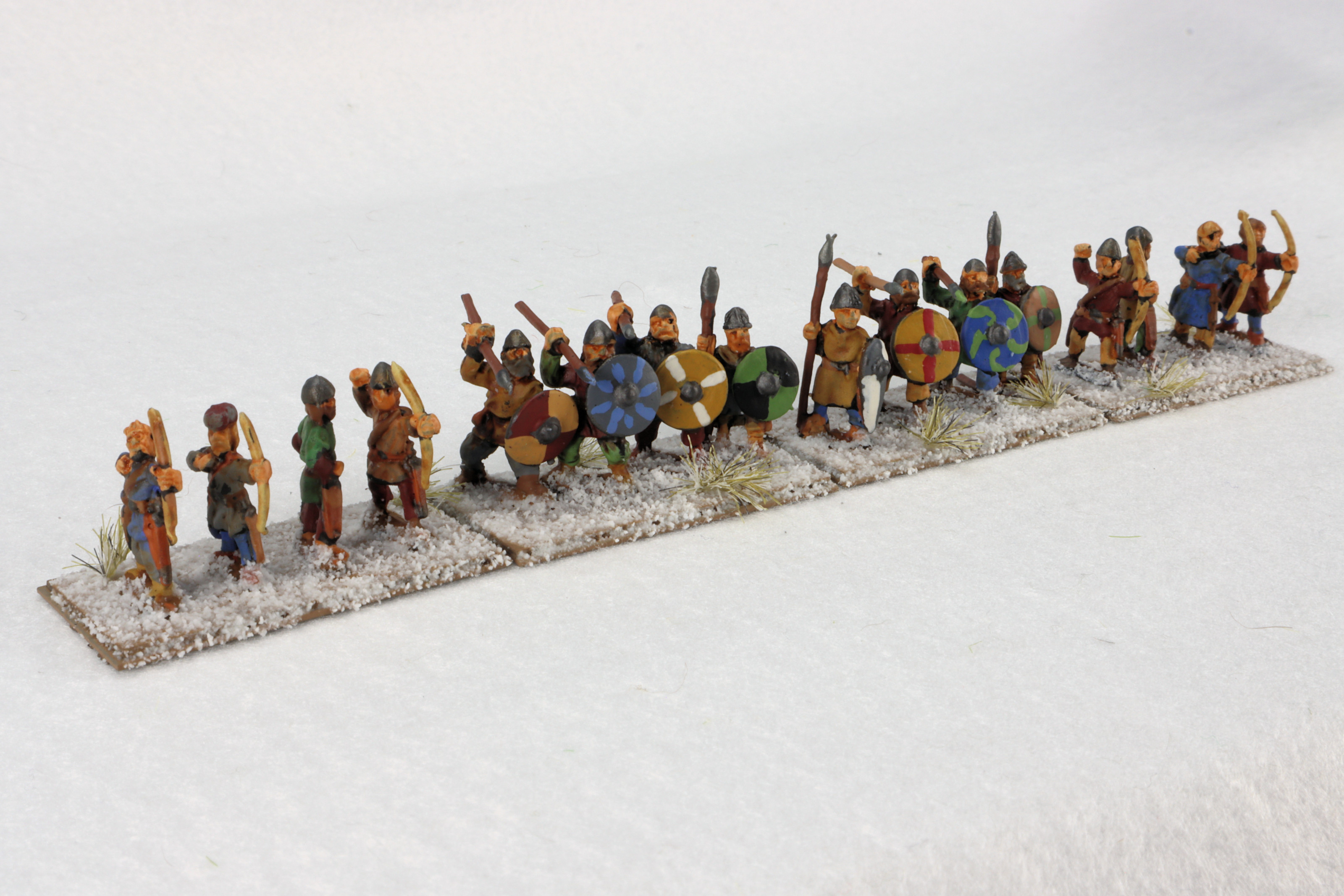
The units were photographed on a white battle mat with lots of additional light so that I could use small apertures such as f22 or f28. This small aperture allows good depth of field with big fron to back focus.
Given the dark figures and the white snow field, I pushed the exposure one stop so the dark figures are better exposed. I probably could have pushed it another stop or two or used a more pinpoint metering. The white snow really throws off the exposure of the figures.
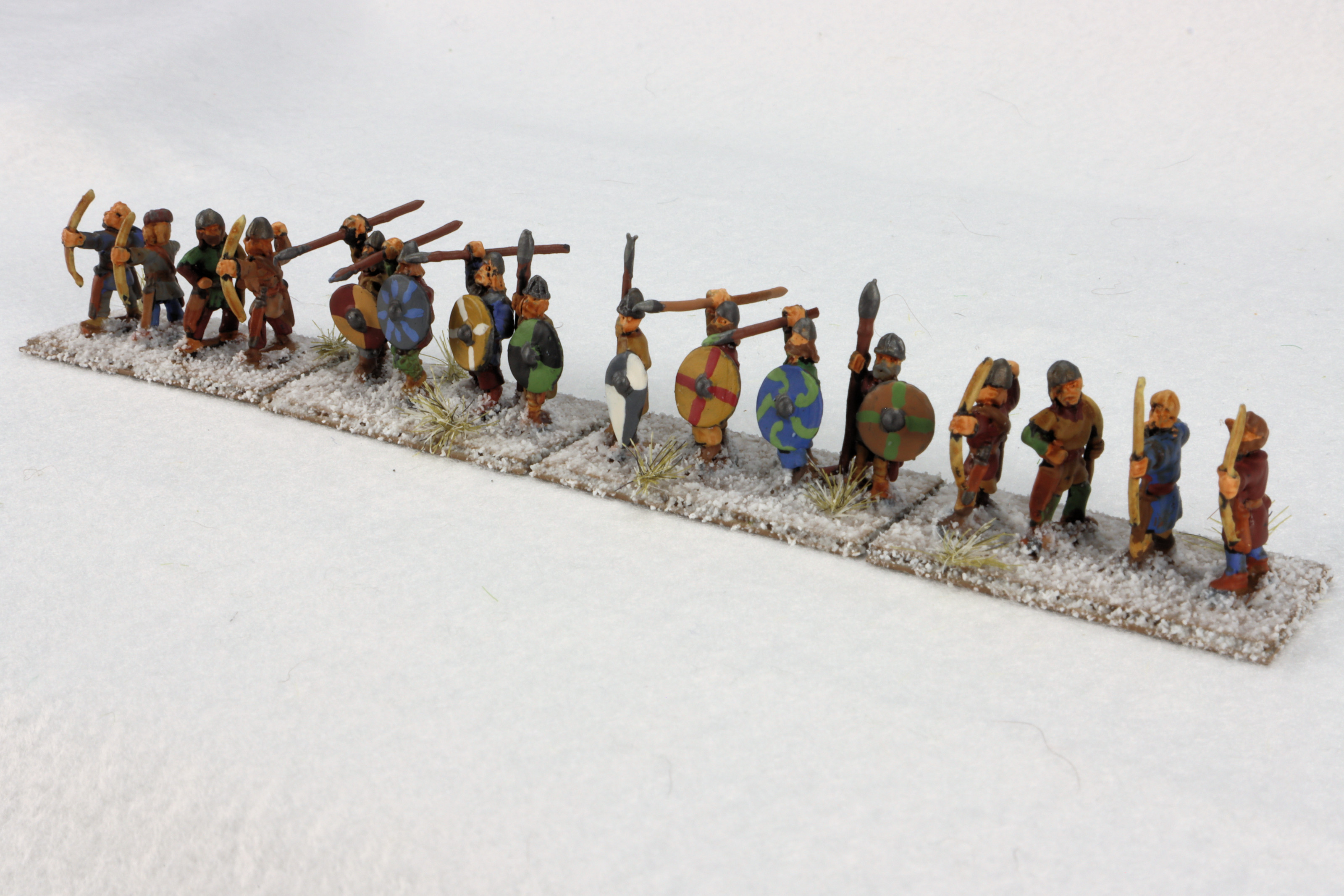
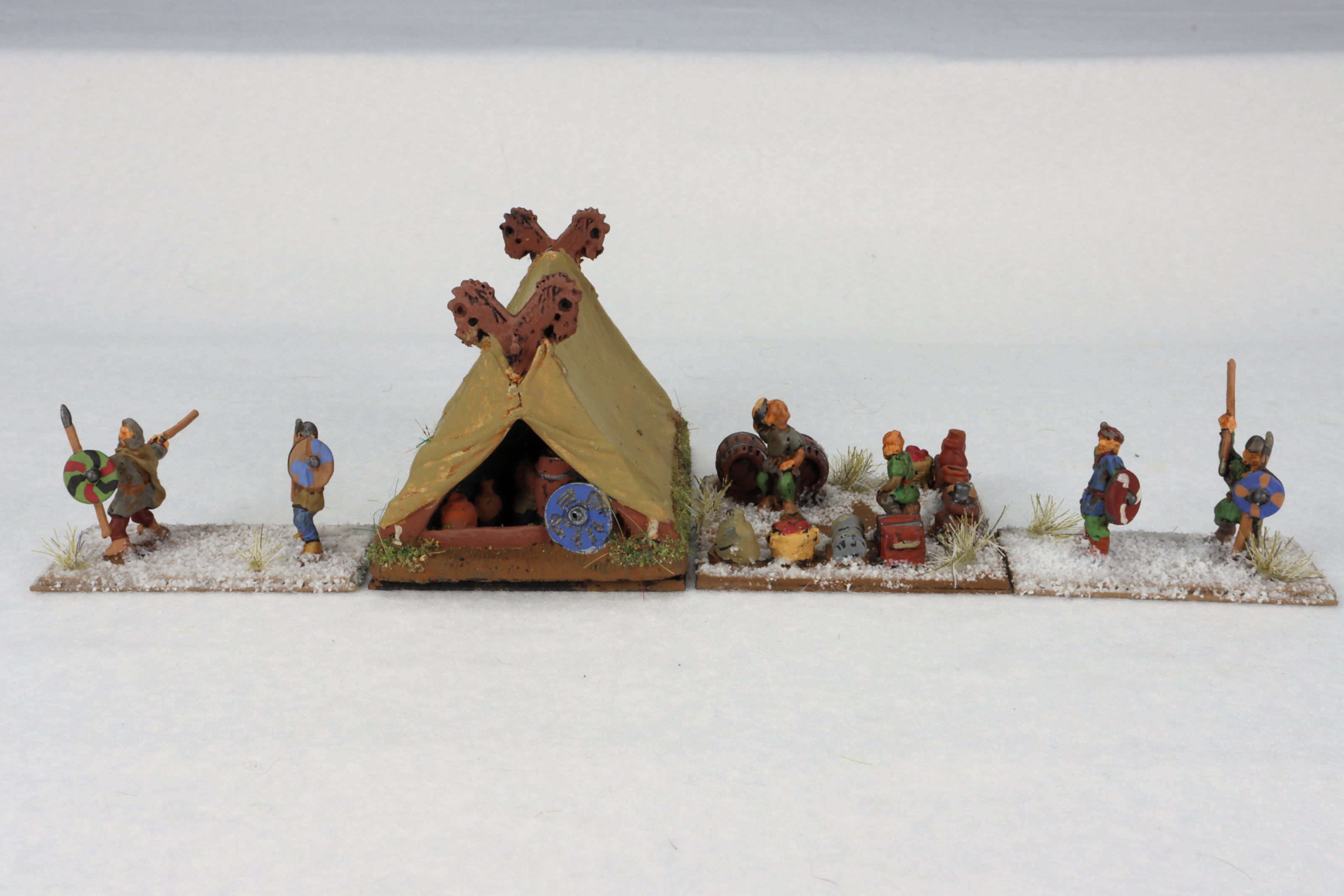
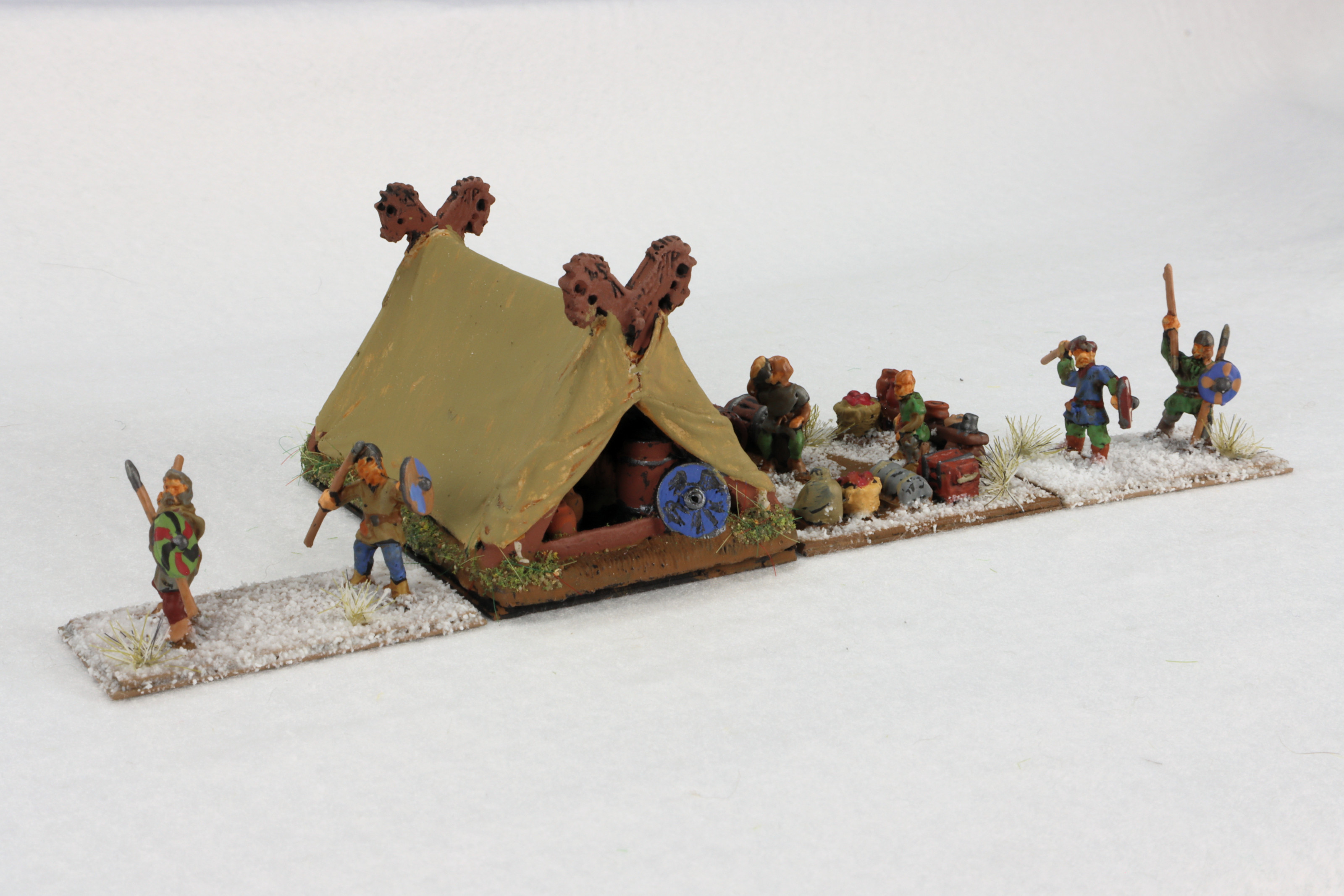
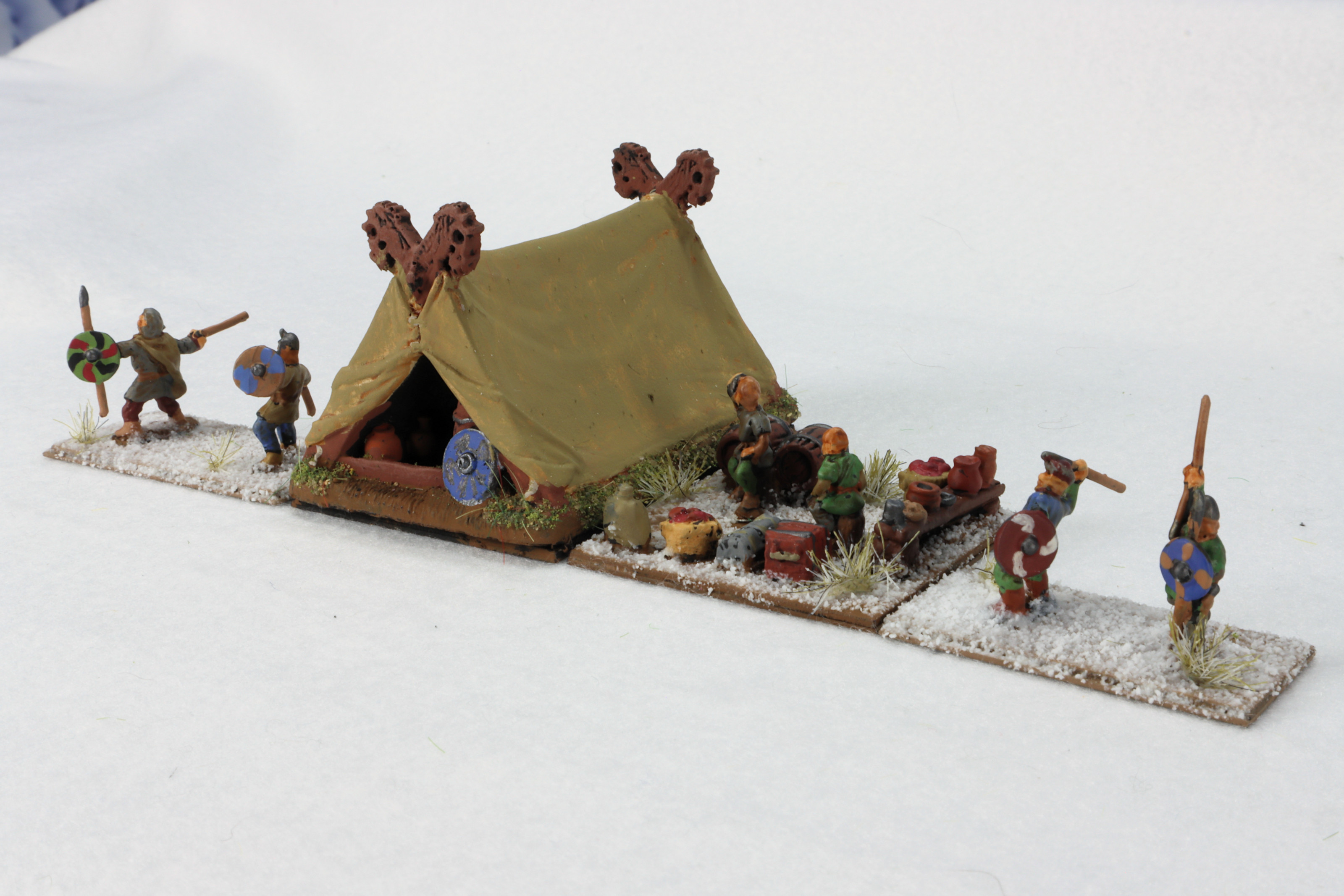
Baueda has very nice camp figures and accessories. This tent has a nice Viking theme.
One minor gripe is that the Viking tent appears to be sized for 28 mm figures given the size of the shield and items in the tent. I like the size of the tent. It looks like a larger command tent. However, the items in the tent look huge.